Showing posts with label cavemen. Show all posts

August 6, 2020

Can you tell whether it's elevating and not racist to compare Black Lives Matter artists to cavemen?

I'm trying to read "New York’s Sidewalk Prophets Are Heirs of the Lascaux Cave Artisans/What street art adorning boarded-up storefronts tells us about our shared political realities and the ways our stories are connected. A critic’s tour deciphers the signs and symbols" in the New York Times.

Maybe to answer my question you need to know more about the racial identification of the writer, whose name is Seph Rodney. I'm just going to give you a sample of the prose:
What became apparent to me is that in the intervening millenniums between those cave paintings and the killing of George Floyd, the messages we share, like the sociopolitical circumstance that impel them, have become more complex. Now street artists take account of the qualified legal immunity protecting police officers, the Black Lives Matter movement and the ramifications of a dysfunctional democracy, among other realities, using a well-developed visual language of cultural memes that illustrate the ideological battles among regional, racial and cultural factions. When we see the image of thin, green-skinned, bipedal beings with teardrop-shaped black apertures for eyes, we typically read “alien.” But when I see the image of such a creature holding a sign that reads “I can’t breathe,” I grok an urgent message: Even aliens visiting from light years away understand the plight of Black people in the United States because this situation is so obviously dire.
IN THE COMMENTS: Jamie said:
I stopped processing his prose before he said "grok," but woke back up when I got there. I hate when people who aren't Heinlein use "grok" to connote their deep understanding... Those people almost invariably missed the point of Stranger In a Strange Land.
The OED has an entry for "grok" — U.S. slang, "arbitrary formation" by Robert A. Heinlein, from 1961. It is defined as "To understand intuitively or by empathy; to establish rapport with" or " To empathize or communicate sympathetically (with); also, to experience enjoyment." The 2 quotes from the book that are in the OED are: "Smith had been aware of the doctors but had grokked that their intentions were benign" and "Now that he knew himself to be self he was free to grok ever closer to his brothers." The OED also gives these quotes:
1968 Playboy June 80 He met her at an acid-rock ball and she grokked him, this ultracool miss loaded with experience and bereft of emotion.

November 3, 2015

"Sometimes, on the internet, text and images get mixed up."

Email from Meade, with this attachment:


That came up on some news site that aggregates automatically. It's not a conscious human mind joking. (Meade touched up the photo to eliminate the images that appeared in the top left and bottom right corners.)

ADDED: This was the news site, ZergNet.

September 4, 2014

The violent imagery deployed against Scott Walker by Debbie Wasserman Shultz is gendered — it's domestic violence.

When Wasserman Shultz says "Scott Walker has given women the back of his hand" and "What Republican tea party extremists like Scott Walker are doing is they are grabbing us by the hair and pulling us back," she evokes domestic violence. Grabbing a woman by the hair and pulling is the classic image of a caveman capturing his sex partner by force. Sociology professor Lisa Wade wrote a piece on the subject (cross-posted at Ms. Magazine):
[T]he caveman-club-’er-over-the-head-and-drag-her-by-the-hair narrative is pure mythology. The mythology, nonetheless, affirms the idea that men are naturally coercive and violent by suggesting that our most natural and socially-uncorrupted male selves will engage in this sort of behavior.  Rape, that is.
If we think of it that way — the feminist way — Wasserman Schultz can be accused of subtly purveying a rape metaphor.

Here's a vivid drawing by R. Crumb showing grabbing and pulling a woman's hair to control and subordinate her during sex: "Big healthy girl enjoys deep penetration from the rear."

Some of the most lurid stories of violence against women extract the dragged-by-the-hair detail for the headline: "Brutal attacker forced woman's head down Burger King toilet before dragging her outside by her hair with the threat: 'You're going to die today'" and "Man dragged ex by hair, tried to run her over, police say." From the Occupy Wall Street blogging at FireDogLake: "Cop Dragging A Woman By Her Hair?" ("Cops especially like the opportunity offered by long-haired females (view above video) to drag such females by the hair across the pavement to be zip-cuffed.") 

Attacking and controlling a woman by using her long hair — the shining emblem of her femininity repurposed as a hand grip — strikes a deep chord. It is a chord I believe Wasserman Shultz meant to strike. She wanted to reach through our conscious, critical mind and stir that most powerful emotion, fear.

To give the back of his hand is a more puzzling expression. I'm seeing it internet-defined as merely an insult, connected to the phrase "back-handed compliment." I think that's confusing "back-handed" with "left-handed." According to the (unlinkable) OED, the figurative meaning of "back-handed" is "indirect, like a back-handed sword-cut." Dickens wrote "Having given her this back-handed reminder" (in "Our Mutual Friend"). But what's a back-handed sword-cut? I think you can picture that easily. And the first meaning of "back-handed" is "With the back of the hand" as in "A back-handed slap across the face." And, indeed, "back-hand" is a verb, and it means "To hit... with the back of the hand." So I think to give the back of one's hand is the way you'd punch if you began with your fist across your chest.

March 23, 2014

Why is it almost only men who like to think they have Neanderthal genes?

From "Most of Us Are Part Neanderthal," reviewing 2 books, "Neanderthal Man: In Search of Lost Genomes," by Svante Pääbo, and "The Gap: The Science of What Separates Us from Other Animals"
by Thomas Suddendorf:
Within a few months of the Neanderthal genome being published, forty-seven people had written to Pääbo claiming that they were Neanderthals; tellingly, forty-six of these were men. Twelve women had also written, suggesting that their husbands were Neanderthals.

January 18, 2014

"For those many, many people who were raised on processed cheese, there is a memory connected with it that can’t be discounted in terms of its importance..."

"It’s a bite of the past, and that trumps flavor every time."

A quote from an article at Smithsonian.com on the history of Velveeta. That's just the next thing that interested me on line, not something I went looking for after that last post, which had food writer Michael Pollan giving us reason to enjoy some of the products of civilization (bread and other cooked foods), absolving us of the sense of obligation to return to whatever it is we imagine nourished the caveman, but not touching upon the mystic chords of memory of the more recent past, the days of mothers in aprons and the things that yielded so willingly to melting in that vividly golden childhood of yore.

And let's remember the psychology of environmentalism. Weren't we just talking about the problem of the industrial byproduct of all that Greek-style yogurt we've been eating? From the Smithsonian article:
[Emil Frey, a Swiss cheesemaker who moved from Switzerland to upstate New York, where he worked in cheese factories in the late 1880s]... figured out how... to help recoup some of the [cheese] factory's waste. He learned that by adding a by-product of cheesemaking called whey, which is the liquid released from curds during the cheesemaking process, to the leftover Swiss bits, he could create a very cohesive end-product. Frey named the product Velveeta....

"Michael Pollan explains what’s wrong with the paleo diet."

What do you mean by "wrong"? All Michael Pollan is saying is that people doing the paleo diet don't know exactly what our ancestors in evolutionary times ate and in what proportions. 

But prehistorical inaccuracy only makes the diet "wrong" if: 1. You adhere to a philosophy or moral code that demands not only that you attempt to ape the apeman but also that doing the best you can yet falling short is a violation, or 2. There is no independent scientific support for the healthfulness of the collection of foods that have been identified under the label "paleo."

I'm not really criticizing Pollan here. He didn't write the headline. It's pointing out the obvious that we don't know that the paleo diet is correct, not that we know it's wrong. Here's his book "Cooked: A Natural History of Transformation," which is oriented around making us feel good about (some of) the food that civilization has made for us.
One problem with the paleo diet is that “they’re assuming that the options available to our caveman ancestors are still there,” he argues. But “unless you’re willing to hunt your food, they’re not.”

As Pollan explains, the animals bred by modern agriculture — which are fed artificial diets of corn and grains, and beefed up with hormones and antibiotics — have nutritional profiles far from wild game.
Can you "beef up" beef? It's already beef. You can "humanize" a human being. But you can't bird up a bird, porkify a pig, or enlambate a lamb.

Here's one of my favorite songs:

February 16, 2013

"Isn’t it odd that the true enemy of society turns out to be that guy in the office down the hall?"

John Hawks extracts a juicy bit from that NYT article about the anthropologist Napoleon Chagnon.

Hawks (who's a paleoathropologist) also has nice closeup of a museum reconstruction of Homo erectus (who seems to be an unusually nice person with lovely skin).

And: A story about a monkey midwife:
I think this is cool not because it shows that monkeys need midwives (they don't) but because it shows that the behavioral flexibility that may have enabled midwifery in early humans is very extensive among primates. A delicious placental incentive may seem inventive, but humans are mystifyingly strange in being among the few mammals who don't regularly consume the placenta after birth.
Note: don't regularly. Not: don't ever. I have Googled it. I know what people do.

January 22, 2013

Harvard prof isn't advocating gestating a Neanderthal.

He's just saying it's "technically possible someday" and "we need to start talking about it today."
[George M.] Church said he has done perhaps 500 interviews about his research during more than two decades and this is the first one to spiral out of control quite like this.

But he said, “I’m not going to run away. … I want to use it as an educational moment to talk about journalism and technology.”
I bet Neanderthals would be better journalists. Let's get some, pronto, to help us with our endless fuckups.

January 21, 2013

"Wanted: Harvard seeks 'adventurous woman' to give birth to cloned Neanderthal baby..."

Second photo down in the right-hand column at Drudge right now:


Link goes to the Daily Mail:
Professor George Church of Harvard Medical School... said: ‘Now I need an adventurous female human. It depends on a hell of a lot of things, but I think it can be done.’
So Drudge changed the quote, substituting "female human" for "woman," actually making the scientist seem less creepy.
He told German magazine Der Spiegel: ‘Neanderthals might think differently than we do. They could even be more intelligent than us.'
Clue to creepy scientists: When you've got a proposal for an edgy medical experiment on human beings — especially when it implies a dream of an improved species — don't use Germans to get your message out.

In fairness to Church... I'm going to assume he's just horsing around, cogitating about what is possible, and that he's certainly not currently seeking that adventurous female human.

January 12, 2013

"The cave of Azykh in the territory of the Fizuli district in the Republic of Azerbaijan..."

"...is considered to be the site of one of the most ancient proto-human habitations in Eurasia."


"The influence of ancient peoples and civilizations including the Sumerians and Elamites came to a crossroads in the territory of Azerbaijan.... In the 8th century BCE, the semi-nomadic Cimmerians and Scythians settled in the territory.... The Assyrians also had a civilization that flourished to the west of Lake Urmia in the centuries prior to creation of Media and Albania."

Today's "History of" country is Azerbaijan. 

August 26, 2012

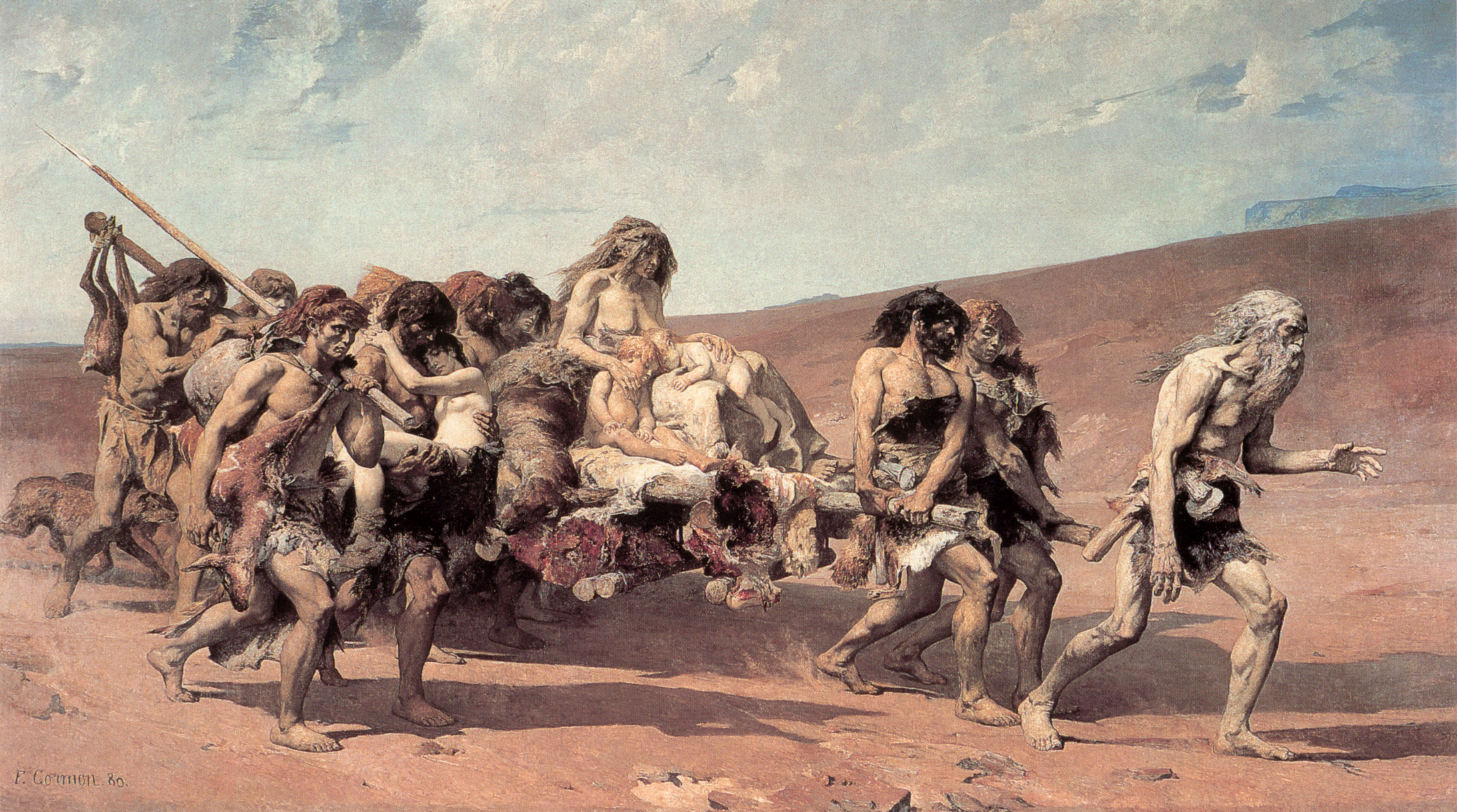
"Althouse and her followers being expelled from the Garden of Bloggen to the Land of HuffPo."

Writes Meade, after I say "So let me slink away and contemplate my own offenses against The Creator." Here's the illustration he sends us to:


(Enlarge.)

What an amazing image! It's an 1880 painting called "Cain flying before Jehovah's Curse," by Fernand Cormon. It's at the Musée d'Orsay (in Paris), so I guess I've seen it, but I don't remember it.
Despite his moment of glory as a Beaux-Arts professor..., [Cormon] was almost forgotten by 1924 when he was run over by a taxi outside his studio, and is barely remembered today save as the teacher of more illustrious pupils.
Here's the relevant passage in the Bible, Genesis 4:16: "And Cain went out from the presence of the LORD, and dwelt in the land of Nod, on the east of Eden." I don't know where he got all those other people going with him or why they looks like cave-folk. I'm guessing Cormon was stoking our doubts — making it look especially bizarre to make us think about how bizarre the Biblical account really is.

December 17, 2011

What is the etiquette for expressing pride in Neanderthal ancestry?

It's very interesting to know that human beings alive today have some Neanderthal ancestry, but wouldn't you like to know exactly what proportion of Neanderthal you are, as an individual?
The result is a rough-and-ready numerical estimate of your Neandertal ancestry fraction. For me it's 2.5 percent. Gretchen is 3 percent, and she's been lording it over me all day.
Is it wrong to express feelings of superiority based on the Neanderthal (or -tal) proportion of your genes? I imagine that in the future there will be individuals claiming to be significantly more Neanderthal than others. Will this be always only the subject for fun, lightweight teasing, or could it cross the line into something too much like racism? And let's say some young person found out he was even more Neanderthal than Gretchen. He's 10%, the highest yet recorded. If he put that on his law school application, would the law school regard it as a diversity "plus factor" on the theory that "'classroom discussion is livelier, more spirited, and simply more enlightening and interesting' when the students have 'the greatest possible variety of backgrounds'"?

ADDED: There's also the possibility that Neanderthal will be taken as a mark of inferiority: "Brian, your words are hurtful."

November 18, 2011

Cain "was showing us a candidate for the presidency of the United States desperately trying to retrieve a soundbite..."

"... and not even trying to hide the fact that he was trying to retrieve a soundbite. Because we're kind of all in on the game, and it is a game, right?"

Writes Peggy Noonan:
The reporter asked him if he agreed, in retrospect, with President Obama's decisions on Libya. Mr. Cain said, "OK, Libya." Ten seconds of now famous silence ensued. Then: "I do not agree with the way he handled it for the following reasons." Another pause, and then: "Um, no, that's a different one."

He was saying: That's a different soundbite.

Later, with an almost beautiful defiance, Mr. Cain told the Milwaukee Journal Sentinel: "I'm not supposed to know anything about foreign policy." That's what staffers are for. "I want to talk to commanders on the ground. Because you run for president [people say] you need to have the answer. No you don't! No you don't!"
But you do, Noonan says. For a GOP candidate to display comfort and even pride in how little he knows plays into the hands of Democrats, who love to argue that Republicans are "not really for anything, they just hate government." Why else would you "blithely dismiss the baseline requirements of a public office, as Mr. Cain does"?
The charge that Republicans just hate government carries other implications—that they're stupid, that they're haters by nature, that they're cynical and merely strategic, that they enjoy having phantom foes around whom to coalesce, like cavemen warming themselves around a fire.
Cavemen? Where did that come from? That seems unfair to cavemen (who were, I assume, very connected to reality and focused on doing what works). Anyway, you see the point. Republicans may favor limited government, but that requires competence too and they're going to lose the election if they don't realize that before it's too late.

April 8, 2011

"I am just about to go crazy today. I just can't seem to escape the 'gay caveman' story."

Oh! The tribulations of paleoanthropology blogging. UW professor John Hawks must hit the ground running when news breaks from the Stone Bronze Age. The news folk are after him for an academic opinion and he says: "Dudes! I could be wrong, but I think that to have a 'gay caveman', you need a skeleton that is both gay and a caveman. And this ain't either!"

IN THE COMMENTS: Maguro said:
So it's probably not a gay caveman after all, merely a Bronze Age Bea Arthur.

What a letdown.
EDH said:
We have rare prehistoric video!

April 7, 2011

"First homosexual caveman found."

How do you figure out that a skeleton is gay? The body was buried "with its head pointing eastwards and surrounded by domestic jugs, rituals only previously seen in female graves."

January 10, 2010

Is my caveman a murderer?

All right, this looks like another one of those articles that made Bob R say "So how long until NYT subscriptions drop down to the level where every subscriber gets an article about them like this? Althouse already had hers." (In case you're new here, my article was this one.)

Anyway, today's Article About You is "The New Age Cavemen and the City":
LIKE many New York bachelors, John Durant tries to keep his apartment presentable — just in case he should ever bring home a future Mrs. Durant. He shares the fifth-floor walk-up with three of his buddies, but the place is tidy and he never forgets to water the plants.

The one thing that Mr. Durant worries might spook a female guest is his most recent purchase: a three-foot-tall refrigerated meat locker that sits in a corner of his living room. That is where he keeps his organ meat and deer ribs.
Is it one of those refrigerator cases with a glass front, so that the hanging meat is a bit of an art display? If I were the woman in that scenario, the first thing I'd think is: How do I know those are not human body parts? Is that the last woman he brought home? I'd be thinking about Jeffrey Dahmer, who had all those human parts in his regular old Milwaukee apartment refrigerator. But now, here's a meat locker in the living room in New York. Is this some kind of artsy upgrade on Dahmer? Would I vocalize my questions and be the sort of nervy comedienne I've always wanted to be or would I be out of there?

As it unfolds, Durant is supposedly living like a caveman. In New York City. At least in the ways that he's decided he can, because, of course, the caveman didn't have a meat locker or even a place to plug one in.
The caveman lifestyle, in Mr. Durant’s interpretation, involves eating large quantities of meat and then fasting between meals to approximate the lean times that his distant ancestors faced between hunts. Vegetables and fruit are fine, but he avoids foods like bread that were unavailable before the invention of agriculture. Mr. Durant believes the human body evolved for a hunter-gatherer lifestyle, and his goal is to wean himself off what he sees as many millenniums of bad habits.
So... it's a diet?
These urban cavemen also choose exercise routines focused on sprinting and jumping, to replicate how a prehistoric person might have fled from a mastodon.
A diet + exercise. Because you know you need exercise too. So buy meat in a store and jump up and down, and it's pretty similar to survival-level hunting on the tundra.
In a city crowded with vegetarian restaurants and yoga studios, the cavemen defy other people’s ideas of healthy living. There is an indisputable macho component to the lifestyle.

“I didn’t want to do some faddish diet that my sister would do,” Mr. Durant said.
Durant wanted a manly faddish diet.
The caveman lifestyle in New York was once a solitary pursuit. But Mr. Durant, who looks like a cheerful Jim Morrison, with shoulder-length curly hair, has emerged over the last year as a chieftain of sorts among 10 or so other cavemen. He has cooked communal dinners in his apartment on East 90th Street and taught others to make jerky from his meat locker.
So the neo-Lizard King's found 10 guys to make jerky with him?

Then, there is Erwan Le Corre, 38, "who once made soap for a living." Soap? No thanks! I've seen "Fight Club"!