Showing posts with label libertarians. Show all posts

April 20, 2026

"He wants to use his presidency not only to slash the country’s budget but to wage an ideological war and rewire the country’s mentality."

"He wants to dismantle what he calls the 'aberrant' concepts of social justice and economic equality and make the nation’s core principles capitalism, the free market, a limited state and individualism. 'We are at war,' Mr. Milei said at a right-wing festival last year, and added: 'We are fighting a cultural struggle, an ideological battle, a war for the survival of our freedom.' At political rallies and international summits, in public policies and a deluge of social media posts, Mr. Milei has relentlessly sought to infuse Argentina with his libertarian ideals. And turn it into a model for the world. A nation where people are loath to eat alone or drink a cup of mate, the national infusion, without sharing with the person next to them is embracing a leader whose fundamental message is that people should fend for themselves. 'He is trying to break our DNA,' Juan Grabois, an opposition lawmaker, said of Mr. Milei. 'To destroy the communal identity of our people.'... Laziness to Mr. Milei is a vice stemming from years of left-leaning governments that turned society to indolence by giving citizens generous benefits...."

From "Javier Milei Wants to Rewire the Argentine Mind/Argentina’s right-wing president has tamed the country’s runaway inflation. Now he wants to transform its values" (NYT)(gift link, because there's a lot going on over there).

And here he is in his superhero costume:

April 6, 2026

"The people who want AI to be off-limits are right that technology changes how you think and write."

"I am old enough to have done creative writing in longhand and then on a typewriter, before I got my first computer. Something was lost in each transition, because the slowness and forced rewriting of the old methods improved the text in certain ways. But they also raised the cost (in time and effort) of making changes, and ultimately most writers decided the new ways were worth it.... There will be artisanal holdouts who reject all those possibilities, but I doubt they’ll be a majority. So for the foreseeable future, the rest of us will be figuring out where to draw the lines, knowing that some lines will be crossed by others, if not erased entirely. The best we can hope for is that in the struggle to draw and redraw them, we’ll learn where they belong...."

Writes Megan McArdle, in "I told the internet I use AI. Boy, was it mad. Artificial intelligence helps you work harder, instead of just outsourcing your brain" (WaPo).

ADDED: I write so I can see what I think. I asked Grok, "Has anyone ever said, verbatim, 'I write so I can see what I think.'" The answer, I'm told, is no, but there's a similar expression, examined in the Quote Investigator article, "Quote Origin: I Do Not Know What I Think Until I Read What I’m Writing."

Notably, Flannery O'Connor wrote, in 1948: "What you say about the novel, Rinehart, advances, etc. sounds very good to me, but I must tell you how I work. I don’t have my novel outlined and I have to write to discover what I am doing. Like the old lady, I don’t know so well what I think until I see what I say; then I have to say it over again." So there was this mythic "old lady" who seems to have been regarded as a fool. In 1927, E. M. Forster wrote of an old lady who said, "How can I tell what I think till I see what I say?"

Why am I writing this as a postscript to McArdle's discussion of A.I.? It's because it explains something about how I've been using A.I.

August 23, 2025

"I'm still mulling the point... about whether or not both parties moved in an individualistic direction and that there were these big solidaristic movements on the left that that began to to fade.... "

"My instinct was it was wrong. And as I think about it, I think it's right, but I think that it's right for possibly a different reason...."

Mulls Ezra Klein, in the new episode of his podcast, "MAHA Is a Bad Answer to a Good Question." I'm jumping you to a spot about half an hour into the discussion:


"I think there's a sense that that politics failed... particularly after 2024... You look around at the way... communal shaming worked. You look at the way people look back on the pandemic. You look at the backlash now to what gets called wokeness, Me Too. And whatever you believe about the underlying arguments being made that the effort to shame your way to a better world was a political failure — not a small political failure, but a political failure that has empowered the absolute worst people, the people you feared the most, like a Murderers' Row of who you did not want to have power.... And the move — I'm not sure if I would call it towards individualism — but away from this heavily enforced solidarity of both action and language — very, very aggressive on speech and info hazards — that that was part of what went wrong....  [T]he left became extremely comfortable with the deployment of state power on behalf of institutions and so on in a way that really radicalized the other side. And the other side didn't become libertarian — in a strange way, they became authoritarian...."

Klein seems to be blaming the left for making the right authoritarian, but isn't he also accusing the left of authoritarianism? What is "heavily enforced solidarity" that's "very, very aggressive on speech and info hazards" — what is it to be "extremely comfortable with the deployment of state power" — if not authoritarianism?

By the way, what is a Murderers' Row? The term goes back to at least 1850, when it referred to a row of prison cells in New York City's Tombs. But most Americans probably think of it in as referring to baseball— especially the 1927 New York Yankees, which had a very intimidating batting lineup. If that's your reference point, Klein sounds like he's expressing awe and admiration for the left's adversaries. Trump is the Babe Ruth of politics.

April 6, 2025

Why were the anti-Trump protests yesterday called "Hands Off"?

That was my first question, and it led to a series of questions:

• Generally, I would think, it is the role of the President to take charge, to handle all problems, and to get things done. A "hands-on" President sounds like an effective, active President, so it sounds as though it is an objection to the elected President being President. That reads as anti-democratic to me.

• If these protesters were libertarian, the slogan "hands off" would make more sense. These would be people wanting government to do as little as possible. But even then, much of what Trump is doing is cutting back government, making it smaller, more like the libertarian ideas. The tariffs are an exception to that, but you get my point. His hands are ON many government programs for the purpose of ending them or cutting them back. The protesters want to preserve big government.

• I think the tariffs are a means to an end of eliminating the tariffs against us. If that's what's really going on then the tariffs are not an exception and could be characterized as getting government out of free trade.

• Trump has been making big moves that have won cooperation from his antagonists. I'm thinking of the universities and law firms that backed down when confronted with financial loss.

• He has good reason to think that huge moves are needed or people will just resist and drag it out and wait it out. He needs shock and awe. The response "hands off" seems weak. Who will "hands off" convince? How did that slogan emerge?

All of that is for the annals of Things I Asked Grok. If you want to see how Grok answered, here's the link. Those are all prompts, by the way, so don't assume I believe all those assertions. It's a bit like teaching law school: You frame ideas to engage your interlocutor. You don't profess belief. You open things up for a better look.

One thing I saw is that the "Hands Off" slogan came from the abortion-rights discourse. But Hands Off My Body is a libertarian concept. 

January 8, 2025

"This shows how Mark Zuckerberg is feeling that society is more accepting of those libertarian and right-leaning viewpoints that he’s always had. This is an evolved return to his political origins."

Said Katie Harbath, "chief executive of Anchor Change, a tech consulting firm, who previously worked at Facebook."

Quoted in "Mark Zuckerberg’s Political Evolution, From Apologies to No More Apologies/Meta’s chief executive has stepped away from his mea culpa approach to issues on his platforms and has told people that he wants to return to his original thinking on free speech" (NYT).
Mr. Zuckerberg has long been a pragmatist who has gone where the political winds have blown. He has flip-flopped on how much political content should be shown to Facebook and Instagram users, previously saying social networks should be about fun, relatable content from family and friends but then on Tuesday saying Meta would show more personalized political content.... 
Mr. Zuckerberg was never comfortable with the involvement of outside fact-checkers, academics or researchers in his company, one of the executives said. He now sees many of the steps taken after the 2016 election as a mistake... two executives said.... Those who have known Mr. Zuckerberg for decades describe him as a natural libertarian, who enjoyed reading books extolling free expression and the free market system after he dropped out of Harvard to start Facebook in 2004....

I'd like to think that the idea of freedom of speech won out in the marketplace of ideas, but I can understand how the speech controllers gravitate toward the idea that Zuckerberg was always a right-winger and he's just regressing after faking aspirations to higher values. 

May 26, 2024

"A lot of people ask why I came to speak at this libertarian convention and you know it's an interesting question."

Watch Trump standing up to boos and pushing back:

ADDED:

May 31, 2023

"Self-identified libertarians have always been tiny in number—a handful of economists, political activists, technologists, and true believers."

"But, in the decades after Ronald Reagan was elected President, they came to exert enormous political influence, in part because their prescription of prosperity through deregulation appeared to be working, and in part because they provided conservatism with a long-term agenda and a vision of a better future. To the usual right-wing mixture of social traditionalism and hierarchical nationalism, the libertarians had added an especially American sort of optimism: if the government would only step back and allow the market to organize society, we would truly flourish.... Had you written a history of the libertarian movement fifteen years ago, it would have been a tale of improbable success. A small cadre of intellectually intense oddballs who inhabited a Manhattanish atmosphere of late-night living-room debates and barbed book reviews had somehow managed to impose their beliefs on a political party, then the country.... Ever since the George W. Bush Administration, the libertarian movement, as such, has been disintegrating...."

Writes Benjamin Wallace-Wells, in "The Long Afterlife of Libertarianism/As a movement, it has imploded. As a credo, it’s here to stay" (The New Yorker).

November 24, 2022

"If you don’t share Musk and his fans’ philosophy, and you thought Twitter was an imperfect but important 'digital public square' as it was, that’s cause enough for 'freaking out.'"

"But if you believe in the power of Musk’s 'hardcore' few, it’s an unprecedented opportunity to show the world the power that’s been repressed by a sclerotic liberal establishment — a dynamic that’s defining this era of politics just as much as this wild moment in the business world."

Writes Derek Robertson in "Elon Musk’s Twist On Tech Libertarianism Is Blowing Up On Twitter/Silicon Valley’s 'cult of the founder' meets modern Republicans’ anti-'woke' culture-warring" (Politico).

Is this a "philosophy"? You'll have to wade through the article.

September 4, 2022

"In 2003, Free Staters chose New Hampshire, with its deep vein of conservatism and 'Live Free or Die' motto, as their prospective homeland..."

"... and more than 19,000 people have since signed a pledge to move to the state, organizers said.... The porcupines, so called because they portray themselves as harmless until provoked, have built a statewide support network for newcomers and member families already here. Porcupine real-estate agents help find housing for the arrivals, others steer them to jobs, and weekly meetups, from pub gatherings to knitting circles, have sprung up across the state.... Parents also have been invited to a discussion on the 'Battle Over Raising Your Child.' 'Your rulers would like to do you the "favor" of taking your children off your hands to "educate" them (with a heavy dose of learning to revere their authority),' its summary read.... Free State leaders... said the group is a big tent whose members range from radicals to pragmatists. The unifying strand... 'is the nonaggression principle, which is an ethical stance that says you cannot force people to do things against their will.'"

From "Free Staters seek to undo New Hampshire government from within" (Boston Globe).

The article relies heavily on quotes from one Free State Project board member, Jeremy Kauffman:

June 16, 2022

"I was terrified of becoming pregnant. I was terrified of putting my life on hold for two-plus years. I don’t want to lose opportunities. I don’t want to be resentful."

Said the actress Jamie Chung — she's in "Dexter: New Blood" — quoted in "An actor’s use of a surrogate raises radical-feminist questions," a WaPo opinion piece by Alyssa Rosenberg. 

Chung, 39, acknowledged that people might assume she was “vain”... [S]urrogacy essentially offloads the discomforts and incapacities of pregnancy onto another woman. Yet there’s something galvanizing about hearing a woman bluntly rage against the limits of biology and the costs it imposes on half the population... 

October 9, 2020

In Wisconsin, the libertarian is polling at 4%. Very strange, considering how crucial the Biden/Trump choice is here.

The Milwaukee Journal Sentinel reports on the new Marquette poll
Biden leads Trump by 46% to 41% among likely voters surveyed, a shade better than his 4-point advantage last month. For the second poll in a row, Libertarian candidate Jo Jorgensen was backed by 4%.... The margin of error for the full sample was plus or minus 4.2%

February 23, 2020

"In a new graphic-nonfiction book, 'Open Borders: The Science and Ethics of Immigration'..."

"... Bryan Caplan, a libertarian economist at George Mason University, makes the radical pro-immigration argument that others don’t. In his view, immigration should be essentially unlimited.... Opening the world’s borders wouldn’t mean abolishing them, Caplan explains.... Governments would relinquish their exclusionary authority, so that anyone, regardless of citizenship, could 'accept a job offer from a willing employer or rent an apartment from a willing landlord.' In one illustration, a cartoon Caplan serves a trillion-dollar blueberry pie; its slices are distributed to landlords with apartments to rent, retirees with newly affordable elder care, and mothers reëntering the workforce thanks to lower child-care costs... Presumably, an open-border policy would lead to a mass exodus [from poorer countries]. And yet an illustrated version of Caplan, working as a Western Union teller, reassures these countries that they would be rewarded with compensatory, monumental remittances. Brain drain wouldn’t be an issue, since the total liberalization of movement would allow everyone—not just the highly skilled—to emigrate.... The illustrations in 'Open Borders' are playful, bright, and irreverent.... [but] they tend to reduce their subjects to caricature. 'Poor countries' are depicted using images of generic slums and anonymous, emaciated brown people; a person who smuggles migrants in the desert is represented as an actual coyote, wearing sunglasses.... "

From "THE CASE FOR OPEN BORDERS/In a new graphic-nonfiction book, a libertarian economist conjures an alternative reality in which immigration is unlimited all over the world" (in The New Yorker).

Here's the book:


I love the way, amidst all that diversity, everyone, including the Statue of Liberty, has the same lipless smile. And every face is saying I'm an optimistic person with simple, practical hopes and all I want is a fair chance to help and contribute. Is it even possible for human eyebrows not to point upward? Everybody means well.

By the way, comic books are a great format for presenting political and policy arguments. I think it's silly, though, to call them "graphic-nonfiction books."

August 23, 2019

"David H. Koch, who amassed a multibillion-dollar fortune with his brother Charles from the corporate behemoth they ran and then joined him in pouring their riches into a powerful right-wing libertarian movement..."

"... that helped reshape American politics, has died. He was 79.... Three decades after David Koch’s public steps into politics, analysts say, the Koch brothers’ money-fueled brand of libertarianism helped give rise to the Tea Party movement and strengthened the far-right wing of a resurgent Republican Party....ince the 1970s, the Kochs have spent at least $100 million — some estimates put it at much more — to transform a fringe movement into a formidable political force aimed at moving America to the far right by influencing the outcome of elections, undoing limits on campaign contributions and promoting conservative candidacies, think tanks and policies.... Under the administration of Donald J. Trump, the Koch brothers’ prospects in Washington seemed improved, at least superficially. But beneath the surface lay substantive political and personal differences between the Kochs and Mr. Trump.... As the 2018 congressional elections approached, the Kochs’ frustrations with Mr. Trump broke into an ugly and open exchange between Charles Koch and the president. Charles denounced Mr. Trump’s restrictive trade and immigration policies as divisive, and threatened to withhold the family’s support for Republican candidates who opposed the free-trade, government-shrinking policies at the heart of the Koch political philosophy. Mr. Trump struck back on Twitter, calling the Koch political apparatus 'overrated' and 'a total joke in real Republican circles.'"

From the NYT obituary.

June 28, 2019

"I missed Buttigieg's closing statement because the dumb NBC News Roku channel interrupted to ask if I'm still watching."

Writes my son John at the end of his live blogging of last night's debate — when he was writing something for each of the closing statements:
10:53 — Swalwell: "I'm a father of a 2-year-old and an infant. When I'm not changing diapers, I'm changing Washington. Most of the time, the diapers smell better."

10:54 — Williamson: "Donald Trump is not going to be beaten just by insider politics talk.… He's reached into the psyche of the American people, and he's harnessed fear for political purposes.… I'm going to harness love for political purposes … and love will win."

10:55 — Hickenlooper seems to have saved up his whole pitch till the end: "We expanded reproductive health to reduce teenage abortion.… We were the first state [Colorado] to legalize marijuana.… We got to near universal health care coverage."

10:56 — Gillibrand: "Women are on fire!"

10:57 — Yang says he'll build "a broad coalition" including "libertarians" — the only time they're mentioned by any of the Democratic candidates.

10:58 — Harris tries to convince us that she should be the nominee based on her prosecutorial background, saying she'll "prosecute the case against 4 more years of Donald Trump."

10:59 — I missed Buttigieg's closing statement because the dumb NBC News Roku channel interrupted to ask if I'm still watching.

11:00 — Sanders, seeming to draw inspiration from President Eisenhower, says he'll fight "the military-industrial complex."

11:01 — Biden promises to "restore the soul of this country — the president has ripped it out." "This is the United States of America! We can do anything if we're together — together."
By then, I'd closed down my computer. It wasn't that I'd got sleepy. I was tired of the rancor. I'm up again this morning at 4 a.m., looking back and assessing what happened to me. I had distanced myself from these people as I was watching, but now I'm thinking of the reality of one of these people becoming President. It wasn't just a funny talk show of wild scary weirdos. It's for real. And I think what happened in my head was: Okay, just give me Biden.

October 6, 2018

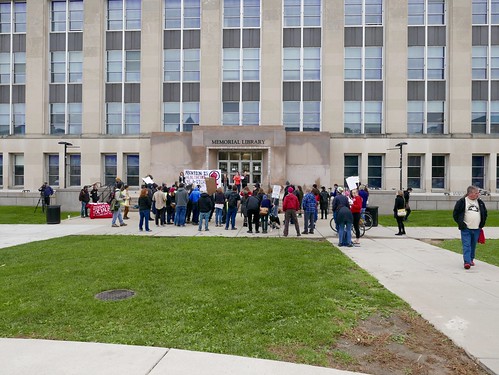
We went down to the University of Wisconsin Library Mall because we saw the announcement from our local socialists: "We must show the ruling class we are not going anywhere."

"If Kavanaugh is approved tomorrow it will only be the beginning of sustained mass movement that will come for more than the rapists and misogynists they put and hold in power. Down with Trump, down with Kavanaugh, down with the GOP, down with the patriarchy and down with capitalism!"


There are a lot of people milling around downtown Madison. It's a Farmers' Market day on the square. It's a big football Saturday, and the game's not until this evening. And there was the big annual Marijuana Harvest Festival right on Library Mall.

And this is what the Socialist flooding of the street looked like.

P1180450

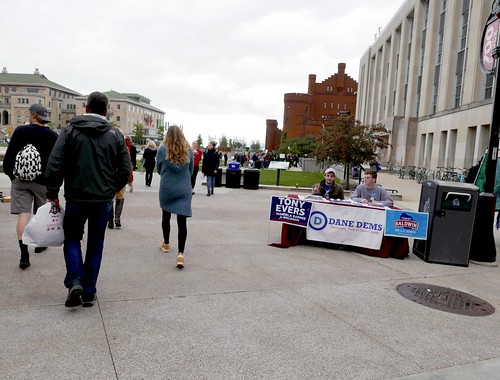
It's not as if anyone was gravitating toward the Democratic Party. People cut a wide swath around this table:

P1180457

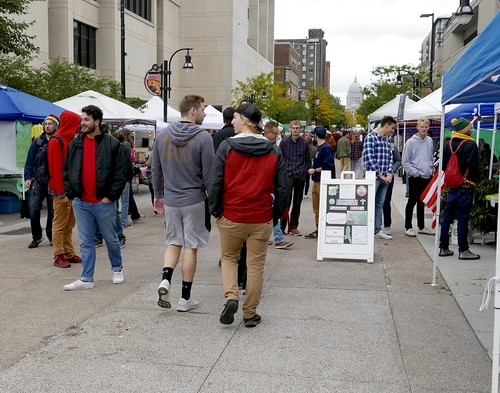
That's the Socialist crowd in the background. A few feet away the mall was teeming:

P1180455

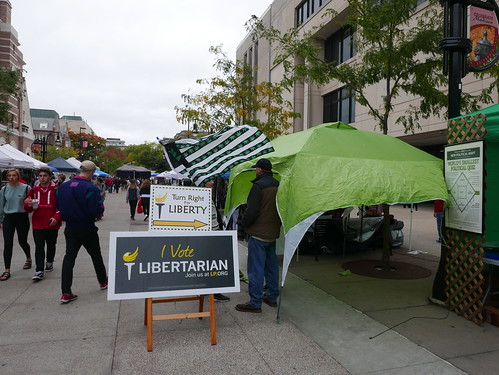
The Libertarians were there, hoping to divert the marijuana-oriented passers-by:

P1180471

It wasn't hard to see what they had to offer:

P1180481

April 5, 2018

Let's talk about The Atlantic firing Kevin D. Williamson — immediately after hiring him.

Here's Adele M. Stan at The American Prospect last week, "The Atlantic’s Gigantic Stumble/When a 'thought-leader' magazine hires the misogynist Kevin Williamson, that’s some kind of leading from behind":
The thing for which Williamson is most famous is his (since deleted) tweet advocating the execution by hanging of every woman who has an abortion. [Jessica] Valenti notes that this would encompass approximately 25 percent of U.S. women.

Williamson’s second-most famous comment is in his contemptuous depiction of a nine-year-old African American boy, which is basically a litany of racist stereotypes strung together, complete with a description of the boy making a gesture Williamson describes as “the universal gesture of primate territorial challenge.”...
So Williamson got the boot.

Here's "By Firing Kevin Williamson,The Atlantic Shows It Can't Handle Real Ideological Diversity/Williamson's rhetoric is inflammatory, but his views on abortion are not beyond the pale" by Katherine Mangu-Ward (Reason). Excerpt:
But the thing that cost him the gig was a remark he made on a podcast well before his firing and in a tweet (since deleted):
And someone challenged me on my views on abortion, saying, "If you really thought it was a crime, you would support things like life in prison, no parole, for treating it as a homicide." And I do support that. In fact, as I wrote, what I had in mind was hanging.
The Atlantic is obviously caving to pressure. They had to know when they hired Williamson that he maintains that abortion is murder, and the fact that he would treat it the way he'd treat any murder is just standard, mundane adherence to principle and resistance to pragmatism. There's nothing to be shocked about. Why hire him if that wasn't what you wanted?

February 15, 2018

"It’s striking to me how many of the architects of [libertarianism] seem to be on the autism spectrum — you know, people who don’t feel solidarity or empathy with others, and who have difficult human relationships sometimes."

Said Duke history professor Nancy MacLean, quoted in "Duke students rebuke prof for saying libertarians are autistic" at Campus Reform. MacLean, who has written a book on the libertarian economist James Buchanan, was giving a long lecture when she was asked if she thought Buchanan was motivated by “personal greed” or “malevolence.” She gave what might have sounded, in context, like an empathetic understanding of his sort of mind — that he, like other libertarians she's observed — seems to be somewhere on the autism spectrum.

“My initial response was that I wanted her to be punished,” said Hunter Michielson, president of the school’s Young Americans for Liberty (YAL) chapter. Michielson realized that punishing the professor was "hypocritical for him as a libertarian," but he decided to do something else that I'll call hypocritical, petition the university to put out an official statement:
“I don’t think it’s too much to ask that the university stand with conservative, libertarian, and autistic students and community members and say that just because you are a libertarian doesn’t mean you are autistic and just because you are autistic doesn’t mean you lack empathy,” Michielson remarked. “College should be a place where you confront difficult opinions,” he added, saying that despite experiencing classroom discrimination for his views, having liberal-leaning professors has been a welcome component of his education given his conservative background.
I'd say, forget the petitions and the official statements and set up a debate or a panel discussion on politics and empathy or human psychology and political preferences. Let's get deep and scientific on what's really going on, rather than take offense and try to scare the person into shutting up.

It seems to me that MacLean is contributing to the marketplace of ideas. It's awkward to drag people with autism in as if you are disrespecting them, but some of that disrespect is coming from Michielson, who says: “I struggle to accept that she actually believes libertarianism or conservatism is the result of autism."

First, MacLean said "seem to be on the autism spectrum." A lot of people — including people we encounter in everyday life who are not overwhelmingly disabled — seem to be on the autism spectrum. It may be a bit offensive to say that, mostly because it sounds disparaging toward people with autism. But MacLean was not "speculating that support for individual liberty might actually be the result of a mental disorder" — as Campus Reform puts it. She was trying to understand Buchanan, after somebody else speculated that he was afflicted by “personal greed” or “malevolence.”

And, frankly, I suspect that libertarians are reacting out of recognition that — however possibly offensively MacLean put it — there is some truth to her observation.

Note: I've incurred the wrath of libertarians for daring to talk about their psychology. Here's a good starting point if you want to examine my motivations.

May 29, 2017

"Here on land, the seasteaders propose, ideas about how to govern societies have stagnated. Politics is too entrenched..."

"... societal change comes slowly, if at all.... Seasteads would upset [the] dynamic, since each floating city would be small enough and modular enough that individuals could come and go freely, shopping for governments and social structures. If residents didn’t like one utopia, they could simply sail off to a new one.... [T]he Seasteading Institute makes clear that it will not be operating the cities itself. The particulars of each seastead’s political system should be determined by its inhabitants—or an oligarch, if that’s the way it turns out. 'Any set of rules is OK,' the organization’s FAQ page emphasizes, 'as long as the residents consent to it voluntarily and can leave whenever they choose.'"

From "Libertarians Seek a Home on the High Seas/The unlikely rise—and anti-democratic impulses—of seasteading," by Rachel Riederer in The New Republic, who observes that the seasteads represent "a very particular set of politics," politics based on the free market," and:
When [government] works, it protects the vulnerable and guards the commons—essential tasks at which the free market so often fails. Ocean dwellers will also need those protections. Much as we might like to, we can’t escape the political, even by walking into the sea.

"Strange to see Althouse on-board with AnCaps/libertarians about the right of businesses to discriminate as much as they like."

Writes James in the comments to yesterday's post about the female-only showings of "Wonder Woman," which I'd discussed in terms of PR for a movie I find mind-crushingly boring. I'd quoted a writer at Wear Your Voice/Intersectional Feminist Media who made hyperbolic fun of the "cishet men" who are acting (feeling?) outraged over the exclusion.

In blogging the controversy, I quite consciously chose to ignore the legal issue. Not everything has to be approached from a legal perspective. There are many paths into a subject, and opting for law talk can foreclose other interesting insights. Teaching law school classes, I would often begin a discussion of a case with the question whether we (or anybody) should want a particular matter controlled by a legal restriction, monitored by the government. It can be more enlightening to open up that inquiry before you get to a discussion of whether what was done in fact violated a statute and whether a constitutional right trumps the statute. It can help you think about how broadly to interpret that statute and that constitutional right.

I didn't want to talk about the law yet. Other bloggers have announced flatly that what the theaters are doing is against the law, and I acknowledge that those laws exist and should be taken seriously. The theaters are exposing themselves to legal proceedings. I can see some plausible defenses. We could talk about freedom of association cases like Boy Scouts v. Dale. This isn't like a restaurant wanting to exclude a particular type of person. The exclusion has to do with the expression of ideas. But I'm not the movie theater's lawyer, and I haven't worked out the argument. 

In any case, there's a such thing as civil disobedience. I don't know if the freedom of women to assemble in a public space and watch a super-hero movie without men in the room is the sort of thing that's worth risking the consequences that are part of civil disobedience, but it's one way to behave in this world and sometimes good things ensue. For example — to get back to the aspect of the controversy I forefronted — PR.

Anyway, thanks for the challenge, James. I had to look up "AnCaps."
Anarcho-capitalists hold that, in the absence of statute (law by centralized decrees and legislation), society tends to contractually self-regulate and civilize through the discipline of the free market (in what its proponents describe as a "voluntary society").
You know, I'm not the type.