Most fingers are pointing west, toward California.... Idaho has few native rat species.... Figuring out where they came from has been a popular, if unscientific, pastime in a region undergoing substantial growth and change, much of it driven by people leaving blue West Coast states for ultrared Idaho. Newcomers have brought dizzying change to Idaho. They’ve driven state politics further to the right, added to traffic woes and helped speed the replacement of farmland with subdivisions. Now rats?...
Kaylee Byers, a public health professor at the University of British Columbia who studied the migration of the rodents in Vancouver, said... “Where you have people, you will have rats”.... The rodents, she added, “are a reflection of us.”
First, the site takes him down, but he's back up, and they're saying that happened because the account was flagged as a possible impersonation. I don't know what Bluesky's rules are about that, because when I searched for "JD Vance," I got various un-cancelled accounts that look like impersonations:
The one with the blue check is the real one, and maybe those others are marked clearly enough. The third account on that list, if you click through, says, in small print "(parody account lol)."
Anyway, what I'm more concerned about is whether JD Vance was able to make himself available for respectful conversation on Bluesky. Here's his set of 3 posts, which highlight Justice Thomas's expression of skepticism about "experts."
Vance says hi like this: "Hello Bluesky, I've been told this app has become the place to go for common sense political discussion and analysis. So I'm thrilled to be here to engage with all of you." I can see that some people are reading that as trolling. It's easy to hear sarcasm.
Vance continues with a block of text from Thomas and the statement "I found Justice Thomas's concurrence on medical care for transgender youth quite illuminating. He argues that many of our so-called 'experts' have used bad arguments and substandard science to push experimental therapies on our youth." And he adds: "I might add that many of those scientists are receiving substantial resources from big pharma to push these medicines on kids. What do you think?"
Does Vance get the "common sense political discussion and analysis" he says, perhaps sarcastically, that he wants?
Said a member of the clergy after in Maria Argyropoulina, in 1004, showed up from Greece for her wedding in Venice with forks (according to a post at Culinaria).
Argyropoulina died of the plague 2 years later, and — what do you have to do to be a saint?! — Saint Peter Damian said: “Nor did she deign to touch her food with her fingers, but would command her eunuchs to cut it up into small pieces, which she would impale on a certain golden instrument with two prongs and thus carry to her mouth. . . . this woman’s vanity was hateful to Almighty God; and so, unmistakably, did He take his revenge. For He raised over her the sword of His divine justice, so that her whole body did putrefy and all her limbs began to wither.”
Here's the Wikipedia article on Saint Peter Damian. Highlights: "[H]e introduced a more-severe discipline, including the practice of flagellation... Another innovation was that of the daily siesta...
Peter often condemned philosophy. He claimed that the first grammarian was the Devil, who taught Adam to decline deus in the plural. He argued that monks should not have to study philosophy, because Jesus did not choose philosophers as disciples, and so philosophy is not necessary for salvation."
So with Damian you get to slough off the difficult studies and take naps... but you've got to self-flagellate. Now, that might seem weird, but it's a trade-off of a sort that lots of people would choose to make if given crisply stated options.
"... who marched through the Piedmont countryside. The epidemic raged through the north, only slowing when it reached the natural barrier of the Apennines. On the other side of the mountains, Florence braced itself. The officials of the Sanità, the city’s health board, wrote anxiously to their colleagues in Milan, Verona, Venice, in the hope that studying the patterns of contagion would help them protect their city.... The poor were judged not only careless but physically culpable.... Along with the poor, other marginalised groups were thought to be 'inclined towards putrefaction.'... Ordinary life was suspended during the epidemic.... The Sanità arranged the delivery of food, wine and firewood to the homes of the quarantined (30,452 of them). Each quarantined person received a daily allowance of two loaves of bread and half a boccale (around a pint) of wine. On Sundays, Mondays and Thursdays, they were given meat. On Tuesdays, they got a sausage seasoned with pepper, fennel and rosemary. On Wednesdays, Fridays and Saturdays, rice and cheese were delivered; on Friday, a salad of sweet and bitter herbs. The Sanità spent an enormous amount of money on food because they thought that the diet of the poor made them especially vulnerable to infection, but not everyone thought it was a good idea... [S]ome elite Florentines worried that quarantine 'would give [the poor] the opportunity to be lazy and lose the desire to work, having for forty days been provided abundantly for all their needs.'... When the epidemic finally ended, about 12 per cent of the population of Florence had died. This was a considerably lower mortality rate than other Italian cities: in Venice 33 per cent of the population; in Milan 46 per cent; while the mortality rate in Verona was 61 per cent....."
From "Inclined to Putrefaction" by Erin Maglaque in The London Review of books (reviewing "Florence Under Siege: Surviving Plague in an Early Modern City" by John Henderson).
"... Some Mongolians believe eating the rodent’s uncooked innards to be 'very good for health,'... The husband and wife reportedly ate the kidney, gall bladder and stomach of the creature.... The 38-year-old man, who worked as a border agent, and his wife, 37, died of multiple organ failure caused by septicemic plague.... Deaths caused by the plague — a disease carried by small rodents that was responsible for wiping out a third of Europe’s population nearly 700 years ago and killing millions in China, Hong Kong and nearby port cities in the 1800s — are much more rare in modern times because of antibiotics, according to the CDC. But reports of people getting infected have continued to pop up around the world, including in the United States, William L. Gosnell, a program director with the University of Hawaii at Manoa’s department of tropical medicine, medical microbiology and pharmacology, told The Post. 'The bacteria maintains itself out in the wild in these animal populations,' said Gosnell, who is affiliated with the university’s John A. Burns School of Medicine. The plague is most commonly transmitted to humans by fleas that become infected from biting rodents carrying the yersinia pestis bacteria, which causes the disease..... Gosnell said he has never heard of a person getting the plague from eating raw rodent meat, but added that 'it wouldn’t be surprising. Any time you eat something raw, there’s always a chance for picking up all sorts of different pathogens,' he said. 'There are so many other zoonotic infections they could have picked up, unfortunately due to the locale, it just happened to be plague.... If you cook it, the bacteria is dead, you don’t got a problem,' he said. 'Some things you don’t eat raw.'"
Sometimes the precise thing you think you need to do for a particular desired goal is an easily avoided thing that is precisely what takes you as far as possible from that goal. In this case, the thing was eating raw marmot organs and the goal was good health. It's completely easy to cook the organs before eating them and cooking them would have destroyed the plague bacteria that killed them, but they seem to have thought that the rawness of the organs was the key to good health, the extreme opposite of death.
I hope it's not disrespectful to the couple who died — I'm sorry they died — to offer their story as a pattern of human decisionmaking. You're hopeful about an exciting idea — like eating raw marmot organs is good for your health — and you do it because you want what the idea says you'll get, so you do it, changing your good-enough condition into something much worse. It's the difference between do something and first do no harm. You might never consider eating raw marmot organs, but I bet that, many times, you've eaten the metaphorical raw marmot organs or voted for somebody who promised he'd make us all eat metaphorical raw marmot organs.
"The kids go out with just stones. That's their weapon. Now they have another weapon: excrement," said a 51-year-old dentist preparing containers of feces in her home for protesters to launch at authorities.
This isn't funny, but terribly sad. People are desperate and not thinking straight.
It seems that people, in their misery, are sinking to the level of monkeys and apes, who are often observed in zoos throwing feces. And yet here I see that "Researches find poop-throwing by chimps is a sign of intelligence." But if you read that closely, you'll see that the study is about the ability to throw, not the choice of projectile:
In this study, we examined whether differences in the ratio of white (WM) to grey matter (GM) were evident in the homologue to Broca's area as well as the motor-hand area of the precentral gyrus (termed the KNOB) in chimpanzees that reliably throw compared with those that do not....
Perhaps you — the human being or the ape — throw what is available. "People are using what they have," said the man quoted in the post title, and apes in zoos are using what they have.
When have human beings used shit as a weapon? Here's a Vice article on the subject. The ancient Scythians dipped their arrows in "a mixture of viper venom, viper corpses, human blood, and shit." In the Middle Ages, "the feces of bubonic plague victims was flung over castle walls with catapults in an effort to infect those inside." There was an "excrement trebuchet bomb" in 12th century China — "gunpowder, human shit, and poison... lit with a hot poker" and launched. And prisoners in America these days throw shit mixed in milk cartons with fruit jelly (for stickiness) and hot sauce (for a burning sensation).
There is also a fascinating case described at that link of an Inuit elder who resisted Canada's forced removal of the Inuit to the high Arctic. With no tools and only 2 dogs, he molded his excrement into a knife shape, which froze into a workable knife — "the shit knife." But he didn't stab anyone with the knife. He butchered a dog, and he used the meat to feed himself and the other dog. And he cut the pelt to make a coat and the guts to make reins for a sled fashioned out of the dog's ribcage, and he escaped.
He's going to Montana to help Greg Gianforte with his campaign for the U.S. House seat vacated by Ryan Zinke (the new Secretary of the Interior). Gianforte is reveling in the the occasion:
"As good Montanans, we want to show good hospitality to people. What can be more fun than to spend an afternoon shooting the little rodents?"
That's quoted at Yahoo News, where the headline says there's "backlash." Backlash at taking out plague-ridden vermin? Who is backlashing?
[P]rairie dogs are also listed as a species of concern by the Montana Department of Fish, Wildlife and Parks because their numbers have declined and because of threats like disease.
More than 100 other animals depend on the prairie dog as food or move into the burrows they dig, said Lindsey Sterling Krank, the organization's director for its Prairie Dog Coalition. Now is the time year when prairie dogs are still nursing their new offspring, meaning hunters who shoot lactating females are condemning the pups to starvation, Sterling Krank said.
"I would love to take Donald Trump Jr. out with a spotting scope and shoot the prairie dog with our cameras," Sterling Krank said. "Shooting a prairie dog colony is not a good conservation message."
Gianforte, whose campaign has focused on gun rights, dismissed the organization's concerns. "Clearly they've never shot a prairie dog," he said. "They don't know how much fun it is."
The lines are drawn. Montanans will vote and get the Congressperson they want. I'll just say I love the name Lindsey Sterling Krank. Oh! I see I've said that before...
... the director of the Prairie Dog Coalition, an "environmental scientist," with the sublimely perfect name Lindsey Sterling Krank....
That was back in 2015, in the context of Boulder, Colorado's Naropa University, which had a big prairie dog colony on land where it wanted to put up some new buildings.
"All of sudden it was, 'The Buddhists want to kill the prairie dogs,' but we had no intention of killing them," said [Naropa spokesman Bill] Rigler, who isn't a Buddhist. "The very act of applying for a [lethal control] permit triggers an open comment period, which gives everyone the opportunity to say, 'I have a site for relocation,' or put forward other ideas."
Off topic, but thought you all should know: I am alive.
Poor Zachary had a ruptured spleen, and in valiant, bloggerly style, blogged it, with photos of himself — in a hospital gown — taken at arm's length. Perhaps the blogosphere is full of photo-essays showing the details of emergency rooms, not to mention accident scenes — wounds and all. (Point to some!)
I once posted "I just wrecked my car!" — and, though I blogged about how, almost immediately, I thought about blogging the accident, I did not get out my camera to get the photos. (Later, at the wrecker's, I got the photos.) So I admire Zachary's presence of mind in taking those photos, especially since he was in pain — though presumably he was also bored and, unlike me at the car crash, not in the presence of victims, police, and EMTs who would have thought ill of me if I'd displayed a hearty bloggerly spirit. (In case you're wondering why my readers didn't seem to give a damn back then, I didn't have commenting turned on.)
Anyway, I love Zachary's intrusion into the late night thread to tell us about his situation. When you go to comment on my blog, you can see that part of the instructions for commenting are: "You can digress, but digress creatively. Amuse us!" So OT was OK. And maybe I should rethink "amuse." Another reason to rethink "amuse" is that people — probably remembering Queen Victoria's most famous quote "We are not amused" — think I'm using the royal "we." I'm not. And actually, neither was Victoria. But speaking of memorable lines... I love "I am alive." It's one of those very short sentences that feel entirely literary.
Is it a famous quote? I Google and see it's at least a video game.
But it has the feeling of something old, something I read long ago. Is it the last line of Daniel DeFoe's "A Journal of the Plague Year"? The e-text is on-line. So:
A dreadful plague in London was
In the year sixty-five,
Which swept an hundred thousand souls
Away; yet I alive!
The drama's done. Why then here does any one step forth?—Because one did survive the wreck.
... So, floating on the margin of the ensuing scene, and in full sight of it, when the halfspent suction of the sunk ship reached me, I was then, but slowly, drawn towards the closing vortex. When I reached it, it had subsided to a creamy pool. Round and round, then, and ever contracting towards the button-like black bubble at the axis of that slowly wheeling circle, like another Ixion I did revolve. Till, gaining that vital centre, the black bubble upward burst; and now, liberated by reason of its cunning spring, and, owing to its great buoyancy, rising with great force, the coffin life-buoy shot lengthwise from the sea, fell over, and floated by my side. Buoyed up by that coffin, for almost one whole day and night, I floated on a soft and dirgelike main.
Perhaps you can help me find "I am alive" (and things close to it) in literary — or cinematic or video-game-ic — works of art. Don't talk about statements in the third person. The first-person statement is the interesting thing here. If you are not alive, you are in no position to comment. By the same token, to say anything is to say "I'm alive." What prompts the always-true words "I am alive" is the consciousness that you might not have been able to say it (or anything else). While it is always within our mental grasp to be suddenly intensely impressed by the vivid fact of being alive, we don't — we could! — say it out loud or write it down... in the comments section of someone else's blog.
Or, no, there is a second reason to say "I am alive." You might need to cry out to someone who thinks you are dead. DeFoe tells of a piper, who went door to door for food and drink "and he in return would pipe and sing and talk simply." But times were hard, and he'd nearly starved, "and when anybody asked how he did he would answer, the dead cart had not taken him yet, but that they had promised to call for him next week." One night, he'd finally gotten some drink, and he was lying drunk in a doorway where the people inside "hearing a bell which they always rang before the cart came, had laid a body really dead of the plague just by him, thinking, too, that this poor fellow had been a dead body, as the other was, and laid there by some of the neighbours." A man named John Hayward loaded both bodies onto the cart:
From hence they passed along and took in other dead bodies, till... they almost buried him alive in the cart; yet all this while he slept soundly. At length the cart came to the place where the bodies were to be thrown into the ground, which, as I do remember, was at Mount Mill; and as the cart usually stopped some time before they were ready to shoot out the melancholy load they had in it, as soon as the cart stopped the fellow awaked and struggled a little to get his head out from among the dead bodies, when, raising himself up in the cart, he called out, 'Hey! where am I?' This frighted the fellow that attended about the work; but after some pause John Hayward, recovering himself, said, 'Lord, bless us! There's somebody in the cart not quite dead!' So another called to him and said, 'Who are you?' The fellow answered, 'I am the poor piper. Where am I?' 'Where are you?' says Hayward. 'Why, you are in the dead-cart, and we are going to bury you.' 'But I an't dead though, am I?' says the piper, which made them laugh a little though, as John said, they were heartily frighted at first; so they helped the poor fellow down, and he went about his business.
But I an't dead though, am I? It's a terrifying question to have to ask, but, thank God, the answer is always "yes."
This is an article by Emil Lesho, David Dorsey, and David Bunner, and I know I would have blogged on that date because it's in an old email file. Back in the days before blogging, I'd send out interesting things I found to a few select correspondents. I've so often regretted not blogging in the years before 2004, and I think from time to time I'll pull an old should-have-been-a-blog-post out of the email. This is really interesting:
Scythian archers in 400 BC and Hannibal in 190 BC were probably the first to "weaponize" biological agents. The former did it by dipping their arrowheads in feces or decaying cadavers; the latter, by launching pottery filled with poisonous snakes onto the ships of King Eumenes during the Second Macedonian War. Plague-infected cadavers were hurled into the fortifications of adversaries during medieval battles and during the famous Mongol siege of the Ukrainian city of Kaffa (now Feodosiya) in 1347.
Later, the development of the trebuchet, an enhanced catapult, made it possible to accurately launch several-hundred-pound loads of manure or large piles of bodies that previously had been too heavy. Although some authors believe cadavers were not competent plague vectors, the prevailing scientific establishment of those times lacked the epidemiologic sophistication to realize this. Biological projectiles had some strategic value--if only psychological--because their use persisted into the 20th century during the Russian Revolution, various European conflicts, and the South African Boer wars.
And consider the horrible Dr. Ishii:
Shiro Ishii, a Japanese Army physician who rose to the rank of general, epitomized physician involvement in the biological war effort. Ishii dreamt of "doctors in combat alongside the glorious infantry." "Alongside" implied offensively using biological agents, not caring for the wounded. Dr Ishii is reported to have offered chocolates filled with anthrax bacteria to children in the Chinese town of Nanking (Nanjing).... Authors credit Dr Ishii with having launched perhaps the most gruesome series of biological weapon experiments in history.
As many as 10,000 prisoners died as a result of having been fed, sprayed, injected, or bombed with a long list of biological and chemical agents, including but not limited to plague, glanders, anthrax, dengue, cholera, and tularemia. Prisoners were given seawater intravenously or horse blood in plasma exchange replacements or deliberately frozen to death to ascertain the effect of temperature on the various pathogens. To determine the effects of barotrauma, they were pressurized until, as one eyewitness put it, "their eyes ruptured and bled." At specifically designated research facilities under Ishii's purview, no prisoners were allowed to survive. If they survived the initial series of experiments, they were then "sacrificed" to determine the progress of the iatrogenesis.
Plague fascinated Ishii. He believed it held great strategic potential and so masterminded the flea bomb, a porcelain structure filled with plague-infected fleas and oxygen. Oxygen sustained the fleas during high-altitude releases, whereas porcelain required less heat and force to shatter during detonation, allowing more fleas to survive. The brittleness of porcelain and a secondary charge ensured that the shell turned to dust, leaving no physical evidence of spent munitions. About 15 million fleas were released per attack. Previously classified documents revealed that at least 11 Chinese cities were attacked with plague, anthrax, and paratyphoid.
From 1940 to 1942, as many as 700 Chinese civilians died because of direct attacks. More than 120 deaths resulted from the aerial dissemination of plague-infected fleas over the cities of Ch'u-hsien (Qu Xian) and Ning-po (Ning-hsien). Because of the indiscriminate nature of biological weapons and the limited experience militaries had in using such weapons, aggressors occasionally succumbed to the diseases that they were trying to inflict on their enemy. During a Japanese assault on the Chinese city of Ch'ang-te in 1941, Japanese forces incurred 10,000 casualties and 1,700 deaths as a result of biological agents.
Here's the (Madison Wisconsin) Capital Times article about Thanksgiving that Rush Limbaugh is about to rage about.
IN THE COMMENTS: Beth says:
Rush Limbaugh is about to rage about something? Stop the presses.
Rush Limbaugh is about to rage about something from Madison, Wisconsin. That stops the presses at Althouse.
UPDATE: Here's the rant. Rush really struggles with the text here, because he wants to conclude that the University of Wisconsin is pushing a -- horrors! -- multicultural curriculum, but it turns out to be about the bubonic plague, not anything about the comparative values and practices of Pilgrims and Indians. He ends like this:
I know it can't be proved because of the two words "most likely." The Indians were "decimated...most likely by a disease." It can't be proven. Nobody knows. This is just a multicultural curriculum which is designed to get as many little kids as possible to question the decency and the goodness of their own country.
That last sentence comes out of nowhere. It's where he intended the rant to end up, but nothing was getting him there, so he just said it anyway. He doesn't always do that, but when he does, it's really screechingly awful.
I nearly got my head bitten off for suggesting as much myself, but now I see that I'm not the only one. That quote is from Rush Limbaugh, said on Monday's show:
... [W]hen Mrs. Clinton was talking about herself, she was radiant, buoyant. She was gesticulating. She was smiling. When it came time to mention, not endorse, mention Obama, she read. There was no gesticulation. There was no animation. There weren't any smiles. A couple of smiles here and there, sort of like a McCain teleprompter smile it didn't fit when she did it.
A McCain teleprompter smile... ha ha... so that's why he bursts into those odd smiles when he does?
[I]n that audience we had true believers. She mentioned Obama's name 15 times. She knew that every time she mentioned Obama's name because of the nature of that crowd that there were going to be people in there that would boo, and there were. And the boos were even audible to me and I am deaf.
Please don't think someone else is writing Rush's monologues!
Now, if you are Mrs. Clinton and you are serious about unifying the party and bringing the party together and you know that your crowd's not happy about what you're going to do, that you're going to quit and they don't like Obama, you only mention his name once or twice, not 15 times. She gave that crowd 15 opportunities to boo Barak Obama. And they did.
So saying his name a lot is the secret code that she's not really quitting?
I'm sitting there watching this and there's simply no way that this was a genuine -- she said the words, but she's looking down as she reads them, and then looks up at the audience in sort of a joker kind of smile kind of permanently on the face, an inanimate smile. I was watching this, and I'm listening to the Drive-Bys, particularly on NBC, and they're just having orgasms. "Oh, this is great, this is wonderful. The party is coming together," and all of this and all of that. And I'm saying, "You guys are so blind and so susceptible to the conventional wisdom. We're talking about a Clinton here. The Clintons don't go away." You'd have to show them a cross at sunup two inches from their eyes and even then they wouldn't go away....
She didn't release her delegates. Hold onto them, hells bells. And she can go out and she can raise money. She has to retire her debt and so forth. She can do that up till the convention. She held on to her delegates, meaning if Obama slips and falls....
I do think he's right. She's in sleep mode and can be reactivated the moment Obama slips too far. The Clintons are watching and waiting.
The last paragraph of a famous book sprang to my mind:
And, indeed, as he listened to the cries of joy rising from the town, Rieux remembered that such joy is always imperiled. He knew what those jubilant crowds did not know but could have learned from books: that the plague bacillus never dies or disappears for good; that it can lie dormant for years and years in furniture and linen-chests; that it bides its time in bedrooms, cellars, trunks, and bookshelves; and that perhaps the day would come when, for the bane and the enlightening of men, it would rouse up its rats again and send them forth to die in a happy city.
"The 20th century, with its scores of millions of supernumerary dead, has been called the age of ideology. And the age of ideology, clearly, was a mere hiatus in the age of religion, which shows no sign of expiry. Since it is no longer permissible to disparage any single faith or creed, let us start disparaging all of them. To be clear: an ideology is a belief system with an inadequate basis in reality; a religion is a belief system with no basis in reality whatever. Religious belief is without reason and without dignity, and its record is near-universally dreadful. It is straightforward - and never mind, for now, about plagues and famines: if God existed, and if He cared for humankind, He would never have given us religion."
So I am reading that Martin Amis book, the one I said I was going to read. That paragraph — from the second essay, written in 2002 — struck me. The line I boldfaced explains the recent atheism fad, doesn't it?
John Tierney wonders, and really, haven't you been worrying about this possibility for a long time?
[I]f you accept a pretty reasonable assumption of [Oxford philosopher Nick Bostrom], it is almost a mathematical certainty that we are living in someone else’s computer simulation....
Dr. Bostrom assumes that technological advances could produce a computer with more processing power than all the brains in the world, and that advanced humans, or “posthumans,” could run “ancestor simulations” of their evolutionary history by creating virtual worlds inhabited by virtual people with fully developed virtual nervous systems....
“My gut feeling, and it’s nothing more than that,” he says, “is that there’s a 20 percent chance we’re living in a computer simulation.”...
It’s unsettling to think of the world being run by a futuristic computer geek, although we might at last dispose of that of classic theological question: How could God allow so much evil in the world? For the same reason there are plagues and earthquakes and battles in games like World of Warcraft. Peace is boring, Dude.
So what does the Big Nerd want from us? And do we have any reason to care? We could try to understand the mind of the Big Nerd for the pure love of knowledge, or we could try to think of how He -- you just know it's a he -- might punish or reward us. The economist Robin Hanson figures that we ought to try to be -- not obedient and moral -- but interesting, so we'll get to continue in the next simulation.
If our descendants prefer their simulations to be entertaining, all else equal, then you should want you and the events around you to be entertaining as well, all else equal. "All the world's a stage, and the people merely players." Of course what is regarded as entertaining does vary somewhat across time and cultures, and our distant descendants' tastes will likely vary from ours as well. So one should emphasize widely shared features of entertaining stories. Be funny, outrageous, violent, sexy, strange, pathetic, heroic, ... in a word "dramatic." Being a martyr might even be a good thing for you, if that makes your story so compelling that other descendants will also want to simulation you....
If you might be living in a simulation then all else equal it seems that you should care less about others, live more for today, make your world look likely to become eventually rich, expect to and try to participate in pivotal events, be entertaining and praiseworthy, and keep the famous people around you happy and interested in you.
On seeing this news, I literally break down and cry for several minutes. The man was 89 years old.
ADDED: Let's look at the list of his films. Talk about the ones that meant something to you. I'll list the ones I remember seeing:
1. "Autumn Sonata." It's the subject of a wonderful discussion about art in (my favorite movie) "My Dinner With Andre." There's a line, something like: I could always live in my art, but never in my life. Ingrid Bergman says it to Liv Ullmann. Mother to daughter.
2. "Face to Face." Isn't this the movie in "Annie Hall" that Alvy Singer refuses to see because it's already started?
3. "The Magic Flute." Mozart! In Swedish.
4. "Scenes from a Marriage." I think of the scene with Liv Ullmann, playing a therapist, as she's listening to a patient describe her marriage. The patient talks about how the world has come to feel unreal to her. Perhaps she says it feels like paper, and we see a closeup of her hand trying to feel the edge of the table. Then we see a closeup of Liv Ullmann's eyes, with just enough terror showing.
5. "Cries and Whispers." Perhaps the best of them all. I think of the scene where they read "David Copperfield" to each other for some reason. And the broken glass and the blood.
6. "The Touch." Elliot Gould! In English!
7. "The Passion of Anna." I remember being bored. Sorry.
8. "Shame." Another one I saw and couldn't appreciate at the time. I should try again, I'm sure.
9. "Persona." This one is very sharp and simple. Great to rewatch.
10. "The Silence," "Winter Light, "Through a Glass Darkly." Hard to remember which is which now. These were the movies we saw in college and thought precisely exemplified what serious movies were.
11. "The Virgin Spring." Another one we saw in college days, but this one stood out as different.
12. "Wild Strawberries." This is the one they showed us in the dorm -- East Quad -- practically as soon as we arrived as freshmen in 1969. The message was: This is greatness in film. If you don't see why this is great, you have a problem you'd better fix!
13. "The Seventh Seal." Loved this at the time. Loved Woody Allen's spoofing of it in "Love and Death." Have it on DVD but only watched part of it. Let's watch this one tonight. It is about death.
14. "Smiles of a Summer Night." Beautiful, funny, and not that Bergman-y. Woody Allen has a beautiful tribute to it: "A Midsummer Night's Sex Comedy."
“I was very much in love with my mother,” he told Alan Riding of The New York Times in a 1995 interview. “She was a very warm and a very cold woman. When she was warm, I tried to come close to her. But she could be very cold and rejecting.”
The young Mr. Bergman accompanied his father on preaching rounds of small country churches near Stockholm.
“While father preached away in the pulpit and the congregation prayed, sang or listened,” he once recalled, “I devoted my interest to the church’s mysterious world of low arches, thick walls, the smell of eternity, the colored sunlight quivering above the strangest vegetation of medieval paintings and carved figures on ceilings and walls. There was everything that one’s imagination could desire — angels, saints, dragons, prophets, devils, humans.”
His earliest memories, he once said, were of light and death:
“I remember how the sunlight hit the edge of my dish when I was eating spinach and, by moving the dish slightly from side to side, I was able to make different figures out of the light. I also remember sitting with my brother, in the backyard of my flat, aiming with slingshots at enormous black rats scurrying around. And I also remember being forced to sit in church, listening to a very boring sermon, but it was a very beautiful church, and I loved the music and the light streaming through the windows. I used to sit up in the loft beside the organ, and when there were funerals, I had this marvelous long-shot view of the proceedings, with the coffin and the black drapes, and then later at the graveyard, watching the coffin lowered into the ground. I was never frightened by these sights. I was fascinated.”...
“I want to be one of the artists of the cathedral that rises on the plain,” he said. “I want to occupy myself by carving out of stone the head of a dragon, an angel or a demon, or perhaps a saint; it doesn’t matter; I will find the same joy in any case. Whether I am a believer or an unbeliever, Christian or pagan, I work with all the world to build a cathedral because I am artist and artisan, and because I have learned to draw faces, limbs, and bodies out of stone. I will never worry about the judgment of posterity or of my contemporaries; my name is carved nowhere and will disappear with me. But a little part of myself will survive in the anonymous and triumphant totality. A dragon or a demon, or perhaps a saint, it doesn’t matter!”
Much more at the link, including how he suffered from the fear of death and what completely cured him of that fear.
IN THE COMMENTS: My ex-husband Richard Lawrence Cohen writes:
Ann, after reading the NYT story my first impulse was to come here and find out your response, which is as perceptive and lively as I'd hoped. (I typoed "livly," which is a nice pun for the occasion!) My earliest Bergman experience was stumbling upon The Magician on WOR-TV in New York as a high school student. It was unlike any other movie I'd ever seen and it made me want to see every other movie like it -- movies that enchanted not only the senses and the emotions but the intellect and the aesthetic. Then Wild Strawberries during freshman orientation as you've noted: I thought I remembered that it was shown in the courtyard of the Quad, but maybe that was King Kong instead and maybe they showed Wild Strawberries in the little auditorium. Then several of his classics at Cinema Guild: among them, Smiles of a Summer Night thrilled me with its laughter-filled ideal of romance, and Virgin Spring with its sagalike bright medieval starkness. Just two weeks ago I rented Seventh Seal for my preteen kids because they were fascinated by the idea of playing chess with Death; they liked that scene well enough but it ended too soon for them and they kept asking, "When are they going to show more of the chess game?" before losing interest altogether. For me, the style of the movie felt a bit old-fashioned at this point but many scenes were still powerful, and I was especially taken with the character of the church artist who kept up a cheerful commentary while painting gruesome pictures influenced by the reality of the plague that was all around him.
A corollary memory: seeing Liv Ullman as Nora in A Doll's House on Broadway in the 1970s, with Sam Waterston as Torvald, Sam on crutches after an accident but still pacing back and forth across the stage, unrealistically, so that he could hit his marks.
Yeah, that was an insane Sam Waterston performance. At least he had historically accurate crutches.
"Wild Strawberries" was shown indoors in a fairly small room, where we had to sit on the floor -- which was one of the reasons I didn't enjoy it as much as I was supposed to.
AND: Richard, if the boys like chess movies, here's a list of 1,715 of them.
AND: In today's vlog, I talk about why reading about Bergman's death made me cry.
MUCH LATER: Having collected my "post-of-the-month" for each of the months of 2007 and chosen this for July, I settle down a reread this post, then go back to the top and read the first sentence and break down and cry once again.
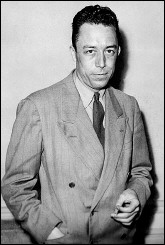
Said George Bush, quoting Albert Camus. Our president just read "The Stranger."
Freedom will be defended.
UPDATE: After writing this post at 10:41, I decided to read "The Stranger," which I have to admit, I'd never read. I have read some Camus. I've even read "The Plague" twice, once in French. And I've read enough books in French that I have to wonder why "The Stranger" wasn't one of them, since the writing is especially simple. Water, red, stones, sky, eyes, light, sweat, knife, gun, belly, blinded, dog, white, sun, glare, trees, tears, God, happy, hope. You could get used to the vocabulary quickly and enjoy the repetitions. But I read it in English today. It's 4:35. It was interesting to read a copy of it that had been in the house for a long time, that my son had read once and filled with marginalia. I couldn't tell whether his notes were influenced by a teacher's lecture or if they were purely his. I had meant to try to think about how the book would have been perceived by President Bush, but that didn't last too long. Fortunately. It would idiotically taint the book to waste any time thinking about President Bush in connection with -- for example -- the group of threatening Arabs:
They were staring at us in silence, but in that way of theirs, as if we were nothing but stones or dead trees.
Sorry not to have some ripe political analysis for you. I suppose I could say President Bush seems to have a complex relationship to his mother, and maybe he thought about that when he read this book, which has a theme of the character's relationship to his mother -- mainly, his seeming inability to feel anything at her death. His reaction is to drink coffee, smoke, sleep, start a new love affair, go to a comedy movie, and go swimming -- something people really take the wrong way. Did you know that Barbara Bush was criticized for not attending her own mother's funeral?
Here are three things The Stranger learned from his mother:
1. "[I]t was one of Maman's ideas, and she often repeated it, that after a while you could get used to anything." (p. 77, Vintage paperback)
2. "Maman used to say that you could always find something to be happy about." (p. 133)
3. (Realizing why Maman had taken a "fiancé" when she was close to death) "Maman must have felt free then and ready to live it all again." (p. 122)
ANOTHER UPDATE: Some more sentences, written on a few hours' reflection.... An ordinary man receives the jolt: his mother has died. His response is ordinary but also extraordinary. He smokes, drinks coffee, and seeks new love, real sensation in his ordinary world. He seems numb and inexpressive, and he follows various characters who lead him into their more fully formed lives. Marie offers love and marriage. He follows without seeing the importance of it. Raymond draws him into jealousy and revenge, and he goes there too, and doesn't see a reason not to. Killing a man or not killing a man seem like equal chances on a coin flip, and, seeing life that way, he kills a man. On trial, his emptiness and his search for sensation, for some feeling of living, become the argument for the prosecution, the reason why he is guilty. Condemned, he thinks it through. He sees the significance of life, even a short life, even a hated life, and finally recognizes that he exists, which is enough, which is everything.
There was no effective treatment for the disease. Medieval medicine was basically a mixture of the ancient “four humors” theory and the astrological formulations of the Arabic physicians of the end of the first millennium. According to the Arab treatises, certain planetary alignments could foster illness by creating miasmas, or clouds of noxious air. In the judgment of many of the fourteenth century’s best minds, that was the cause of the Black Death. Some cities took public-health measures—mainly, quarantines. People were advised to avoid pore-opening activities (bathing, exercise, sex), so as to prevent the miasma from penetrating their skin.
The New Yorker reviewer thinks this new plague book is too padded, and recommends Norman Cantor’s 2001 “In the Wake of the Plague: The Black Death and the World It Made” instead. Cantor's book is better, we're told, because instead of wallowing in grim descriptions of buboes, it talks about the social and political consequences of living in a world suddenly bereft of one third of its inhabitants. Law students may like to know that "the most enthralling chapter has to do with property law."
In the course of their quarrels, the gentry and the nobility put aside old codes of civility, and that development, together with certain very striking national events—notably the ouster and probable murder of Richard II by Henry Bolingbroke, at the end of the century—created what Cantor calls a “new dark age of bad behavior.” The modern conviction “that unrestrained greed is good” was born. The new property legislation controlled it but also fostered it, by encouraging people to do whatever the law would let them get away with.
And if it's something to be desired, how is it like the flu? The point is everyone wants momentum, but what's "spreading ... like the flu" is claiming to have momentum. Once again, writers like to cram a lot of material into a single sentence. Writing two sentences is something they resist like the flu, which is not as bad as the plague.
"We have a ton of momentum," said a spokesman for Representative Gephardt, of Missouri.
Seems like a ton would weigh you down.
More from Hulse:
Candidates crave momentum and hope to ride it like a wave. The problem is that it is difficult to gauge who is actually moving forward and who is engaged in wishful thinking. The laws of physics would seem to preclude everyone from having momentum simultaneously.
I'm no physicist, but it seems to me that if Kerry, Gephardt, Dean, Edwards, and Lieberman tucked into the summersault position at the top of a hill, momentum would simultaneously favor them all. They could all also "ride ... a wave" simultaneously, and I for one would be interested in following their choice of surfwear.
Hulse also treats us to a great old momentum quote--from Old Bush:
It was the first George Bush who shook hands with what he called "Big Mo" after he won the Iowa caucuses in 1980. "I suppose I am out of the pack," he said in a classic bit of political analysis, "but they will be after me, howling and yowling at my heels. What we will have is momentum. We will look forward to Big Mo being on our side, as they say in athletics."
I pause for a moment of Old Bush nostalgia. Who else could talk like that, coming up with "Big Mo," then calling sports "athletics"?
I am a participant in the Amazon Services LLC Associates Program, an affiliate advertising program designed to provide a means for me to earn fees by linking to Amazon.com and affiliated sites.
Encourage Althouse by making a donation:
Make a 1-time donation or set up a monthly donation of any amount you choose:




 Posts
Posts


