RIP.
ADDED: I am stunned. I can't believe he's gone. He has been so important for so long. It's hard to believe there's a news story capable of overshadowing Katrina. I wonder what Bush will do. Do you think he might elevate Justice Thomas to Chief Justice? Do you think Judge Roberts will be chosen? A new era is upon us. What an effect this man has had! He was one of the greatest Wisconsin citizens ever, born here in Milwaukee, in 1924.
September 3, 2005


"A least 200 New Orleans police officers have walked away from their jobs and two have committed suicide."
Reports the NYT:
From the Superintendent of Police Eddie Compass:
Would the NY Police have reacted to adversity that way? Think what they did after 9/11.
IN THE COMMENTS: I want to quote something I wrote in there:
Some officers officially told their superiors they were leaving, police officials said. Others worked for a while and then stopped showing up. Still others, for reasons not always clear, never made it in after the storm.
From the Superintendent of Police Eddie Compass:
"If I put you out on the street and made you get into gun battles all day with no place to urinate and no place to defecate, I don't think you would be too happy either... Our vehicles can't get any gas. The water in the street is contaminated. My officers are walking around in wet shoes."
Would the NY Police have reacted to adversity that way? Think what they did after 9/11.
IN THE COMMENTS: I want to quote something I wrote in there:
Let me just say that I think my post is too harsh. I understand the pressure these people face. I doubt that I would do better. But I wish there were more stories of heroics after Katrina. I keep thinking of 9/11 because there were so many positive stories to counterweight the horrible then. 9/11 was a story of great evil and great good in human beings. Katrina is more of a story of ordinary things: nature and imperfect people.
Salvation Army.
I see that my BlogAd from TheCapitol.net turned into a Salvation Army ad. That wasn't my doing. They contributed the ad spot they bought from me to the Salvation Army. Very nice! (The Mercy Corps ad is one I put up free.)
Katrina political rhetoric.
Can you imagine what it would be like if the governor of Louisiana and the mayor of New Orleans were Republicans? Lots of tricky rhetorical twistiness is needed to pull off the blame Bush maneuver. Or — oh hell, why bother? — just blame Bush for everything. After all, the mayor cried. And the governor is all sad-faced. Bush is squaring his jaw and doing that cowboyish walk and talk. Doesn't that make you so mad? He doesn't care!
Katrina and segregation.
Bearing Blog writes about an interview on NPR with Betty Hearn Morrow, a disaster sociologist. (The audio should be available here at 1:00.)
Bizarre. This morning on NPR's Weekend Edition: a sociologist tries to explain to Linda Wertheimer, without using the word "segregation," that the relief workers will be intentionally racially segregating the emergency shelters. I think the link is here.Has everyone forgotten about Johnson v. California, a case the Supreme Court issued back in February?
She's going on about how people want to be with their own "cultural group" and how tensions will be lower that way. This may or may not be true, but what's interesting to me is the linguistic somersaults she's putting herself through to avoid saying "we will segregate the shelters."
The Supreme Court ruled ... that California must abandon its policy of assigning inmates to racially segregated cells for as long as 60 days when they arrive at new prisons -- unless the state can prove it has no race-neutral way to prevent interracial violence.I wonder what the civil rights cases coming out of Katrina will look like. If the issue of segregating refugee shelters worked its way up to the Supreme Court, would the Johnson dissenting view prevail?
A five-justice majority rejected the state's contention that the court should defer to the judgment of the corrections officials who deemed the unwritten policy necessary to prevent members of race-based gangs from turning on one another in two-man cells. The state also argued that its policy affects members of all races equally. The court said California's policy must withstand the same "strict scrutiny" as all other racial classifications.
"We rejected the notion that separate can ever be equal . . . 50 years ago in Brown v. Board of Education, and we refuse to resurrect it today," Justice Sandra Day O'Connor wrote in an opinion that was joined by Justices Anthony M. Kennedy, David H. Souter, Ruth Bader Ginsburg and Stephen G. Breyer.
"When government officers are permitted to use race as a proxy for gang membership and violence without demonstrating a compelling government interest and proving that their means are narrowly tailored, society as a whole suffers," O'Connor added.
[Justice Stevens, writing separately, took an even stronger anti-segregation position.]
Justice Clarence Thomas said the majority put concern for the "indignity and stigma of racial discrimination" ahead of inmates' "safety and . . . lives."John Roberts will have replaced Justice O'Connor (unless something very strange happens), but the Johnson majority would still have five votes. It will be interesting to see what effect transformed microcosmic society of the Court will have on Anthony Kennedy.
In a 28-page dissenting opinion that was nearly twice as long as the majority opinion, Thomas, joined by Justice Antonin Scalia, said California authorities need latitude to deal with such gangs as the Crips and the Aryan Brotherhood. Its policy, he wrote, "is reasonably related to legitimate penological interests."
"A J-School question."
From Mickey Kaus:
Has the network TV coverage of the N.O. Superdome fiasco a) made the situation seem to be worse than it really was (because TV always focuses on the negative things--the crime, the snafus, the corpses and complaints, etc.) or b) made the situation seem better than it really was (because network TV didn't want to make it look as if a heavily African-American crowd of refugees couldn't behave itself)? ... I was going to guess a) until I read this.His link is to that BBC story about the 50 British tourists escorted out of the Superdome, which we discussed here yesterday. My concern was with whether the National Guard were taking the problems of white people more seriously than those of black people, which is quite different from what Kaus is asking. He's wondering about which way the journalists are bending things.
Triage.
Rabbi Marc Gellman:
Comments?
What looks like unfeeling cruelty on the TV screen is most likely the result of hard but decent choices made by people who see exactly what we see, but who, unlike us, are charged with facing the chaos and turning it into hope....
Triage is not a way to decide whom to kill. Triage is a way to decide whom to save so that in the end the most people can be saved. Triage choices are tough, but they are necessary because doing nothing is a choice, and because following the loudest scream is a choice, and because only helping those on television is a choice, but all those choices are driven by impulse and are not supported by coherent moral values. If the resources were unnecessarily limited, and if the triage decisions were made in error we will know in time. The point now is that any finger-pointing must be mollified by a good dose of trust, humility and patience. Just because we see a helicopter on the news flying over a group of victims here does not mean that the helicopter is not following a triage decision to save a group of more needy victims there. Triage is where morality meets reality. It is precisely at times of chaos that morally informed but tough-minded triage decisions must be made, otherwise morality is simply a dilettante’s luxury and a mere intellectual puzzle for the philosophy classroom, but irrelevant on the street.
Comments?
"Any First Amendment decision, right or wrong, will reverberate more readily through the law than a decision made in any other area."
That is what lawprof Seth Chandler discovered, in an elaborate computer-based study of Supreme Court cases, reports The Economist. As a Federal Jurisdiction lawprof, I was especially interested to read this:
But the federal jurisdiction cases "are not ... the cases that are most tightly bound into the network":
Fascinating!
He found the most important opinions, at least judged by how many times they were cited, by working out which nodes were likeliest to fall on the shortest paths between two other nodes. Intriguingly, the cases mostly come from an advanced and esoteric subject—the law of federal jurisdiction—that addresses structural features of American government, such as the relationship between the states and the federal government and the relationship between the courts and Congress.
But the federal jurisdiction cases "are not ... the cases that are most tightly bound into the network":
To find the network's so-called main core, Mr Chandler repeatedly filtered out less-connected cases. He found that most of the cases in the main core interpret the American constitution's First Amendment, which protects freedom of speech and free exercise of religion. This, he suggests, means that deciding a free-speech case requires understanding a more complex body of precedents than deciding any other kind of case. By the same token, any First Amendment decision, right or wrong, will reverberate more readily through the law than a decision made in any other area.
Fascinating!
"I have found it personally inspiring in my war on political correctness in academe. "
Says Camille Paglia about Dylan's "Like a Rolling Stone." But she doesn't think it deserved to be #1 on that list of greatest songs put out by Rolling Stone. That should have been something by the Rolling Stones. The flaw of "Like a Rolling Stone" is "compulsive sneering - an adolescent tic," per Paglia. But, wait, isn't adolescent sneering the point of rock and roll? It's hard to do adolescent sneering well. And once you've done it well, if you try to get past it, John Pareles might pillory you in the New York Times.
Fats Domino.
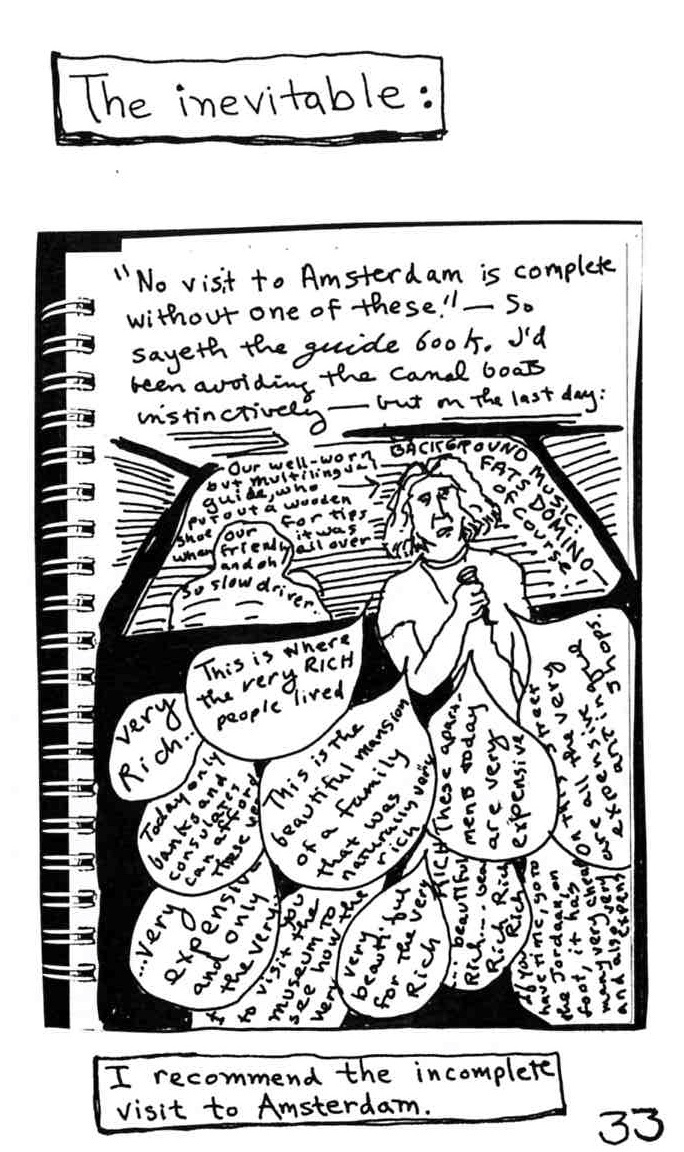
I see Fats Domino turned up in that last page of The Amsterdam Notebooks: that annoying little tourboat played his music, just one more example of old American popular music playing incongruously in Europe. Fats Domino has also been in the Katrina news. Here's the story of how he told his agent to pray for him because he wasn't going to leave New Orleans. His house flooded to a depth of 20 feet, and he was rescued by boat, but for three days, he failed to call the agent or his daughter, who were frantically searching for him. He'd gone to stay with a friend in Baton Rouge, where he watched the TV reports about the aftermath of the hurricane.
The Amsterdam Notebooks—Page 34.
It's Day 34 of this 35 day project. Tomorrow's the last one. Here's the set thus far.
This page records my venture onto one of those tour boats that show you around the canals. After avoiding them through my entire trip, I yielded to the inevitable on my last day in the city. I loathed the experience.
The guide with the monotone voice had one theme:

(Enlarge.)
This page records my venture onto one of those tour boats that show you around the canals. After avoiding them through my entire trip, I yielded to the inevitable on my last day in the city. I loathed the experience.
The guide with the monotone voice had one theme:
(Enlarge.)
September 2, 2005
"Maybe, because of this hurricane, we got our press corps back."
Said Bill Maher, just now, on his HBO show, finding what he called a "silver lining." He's interviewing Anderson Cooper who displayed some passion and anger about hurricane relief. Maher's theory is that the hurricane experience will cure reporters of what he thinks is their supine acceptance of what Bush tells them about the war. Cooper distances himself from the question.
Contributions.
Everyone's made a contribution for hurricane relief by now, right? If not, here's the link to make a donation to the American Red Cross. You can also click on the Mercy Corps blogad over there. (A free ad, in case you're wondering.)
To Loyola and Tulane lawprofs.
Here's a message from the UW Dean's office:
If you know of anyone on the faculty at Loyola or Tulane law schools who would like a place to settle temporarily, the Dean's Office at UW-Madison law school will welcome them here and provide some kind of non-paying visitor/fellow status that will entitle them to access to UW libraries and such. We'll scout for office space in the building (probably squatting in rarely used or shared offices) and make every effort to match them up to folks on our faculty with a guest room. Let them know we are here to help, if they need it. Inquiries can be directed to:
R. Alta Charo, racharo (at) wisc (dot) edu
Associate Dean for Research and Faculty Development
University of Wisconsin Law School
5211C Law Building, 975 Bascom Mall
Madison, WI 53706
Refugees.
When was the last time Americans were called refugees?
There's an old Woody Guthrie song "Dust Bowl Refugees":
There's an old Woody Guthrie song "Dust Bowl Refugees":
Yes, we ramble and we roamOnce drought made Americans refugees. Now it's water.
And the highway that's our home,
It's a never-ending highway
For a dust bowl refugee.
"The reason I'm mad as hell over Katrina is precisely because I'm a conservative and this kind of thing is exactly what government is for."
Andrew Sullivan writes:
But I note that Sullivan doesn't address the line between the federal government and state and local government. Basic order is the responsibility of the city, which failed catastrophically here. The state also has an important backup role, which it seems to have performed badly. The role of the federal government in funding public projects is more complex. I think Drum is right that liberals are more willing to keep taxes high and fund more projects. And I tend to think the federal government should be blamed for not spending the money to solve the glaring disaster-waiting-to-happen that was New Orleans.
Kevin Drum wants to say that the difference between conservatives and liberals is that liberals believe in funding organizations like FEMA or the Corps of Engineers and conservatives don't. Nuh-huh. Real conservatives believe that the state should do a few things that no one else can do - defense, decent public education, police, law and order among the most obvious - and leave the rest to individuals. Funding FEMA and having a superb civil defense are very much part of conservatism's real core. It's when government decides to reshape society, redistribute wealth, socially engineer, and take over functions that the private sector can do just as well that conservatives draw the line. The reason I'm mad as hell over Katrina is precisely because I'm a conservative and this kind of thing is exactly what government is for. Bush in this sense is not now and never has been a conservative.Like Drum, who responds to Sullivan in an update, I don't know what the "real core" of conservatism is. I note that good rhetoric can be squeezed out of such ideas. I'm the real conservative. No, I am. I don't personally care that much about that sort of debate. I don't define myself as a conservative and am continually bemused by the tendency of other people to call me conservative. But I do agree with Sullivan that this is what government is for — especially, I would add, when you're talking about restoring order.
But I note that Sullivan doesn't address the line between the federal government and state and local government. Basic order is the responsibility of the city, which failed catastrophically here. The state also has an important backup role, which it seems to have performed badly. The role of the federal government in funding public projects is more complex. I think Drum is right that liberals are more willing to keep taxes high and fund more projects. And I tend to think the federal government should be blamed for not spending the money to solve the glaring disaster-waiting-to-happen that was New Orleans.
Katrina politics.
Kos (and presumably other sites) are savaging Bush over Katrina. What's missing is criticism of state and local government. Justified outrage about the response to Katrina is — not surprisingly — merged with the usual partisan politics. On the other side, people are excusing Bush and putting all the blame on state and local government. How hard is it to play it straight here? I'm going to try.
Special treatment?
What is your opinion of the racial dimension of this story? Think carefully before answering.
UPDATE: Sorry I had the link wrong. This is a specific story about how British tourists at the Superdome were treated. NOTE: I'm deleting the comments that unfortunately addressed the wrong question.
UPDATE: Sorry I had the link wrong. This is a specific story about how British tourists at the Superdome were treated. NOTE: I'm deleting the comments that unfortunately addressed the wrong question.
Subscribe to:
Posts (Atom)


 Posts
Posts