September 17, 2005


"'Blogs,' which is to say thoughts ... made available on the internet. "
Gordon Smith has fun reading some sentences, which is to say thoughts, written by the dean of the University of Chicago Law School. The dean, Saul Levmore, writes:
And why capitalize "Roundtable"? That, in itself, bespeaks an unbloggish pomposity.
UPDATE: A commenter points out that the University of Chicago Law School has a journal called Roundtable and a long tradition of using the name Roundtable for various scholarly efforts.
Our plan is to experiment with a faculty blog, perhaps by asking a different faculty member to post some thoughts for a one- or two-week period before turning over the lead to a colleague. This point-person would ensure that there is frequent new material on our Law School blog, but ideally other faculty members would regularly post as well, so that we might have a kind of public Roundtable.Gordon asks:
If a University of Chicago Law School blog is a good idea, why doesn't it happen spontaneously? The costs of entry into blogging are very low, so experimentation is easy, and the faculty already includes a number of experienced bloggers.It strikes me as weird to send out a letter to alumni saying the faculty is going to start a blog experiment. Since anyone, any minute, can start up a blog, it's not like planning a new law school building. Do the blog, and if it works our well, call attention to it. But saying hey, we're going to have a blog, is not just lame, it's risky.
And why capitalize "Roundtable"? That, in itself, bespeaks an unbloggish pomposity.
UPDATE: A commenter points out that the University of Chicago Law School has a journal called Roundtable and a long tradition of using the name Roundtable for various scholarly efforts.
"There's a fine line between doll and cool, between sugar plum fairy and rock-and-roll Ophelia."
Makeup. From "mere mortals into glossy goddesses." From Jennifer Lopez into "ultra-groomed Grace Kelly doppelgänger." From Christina Ricci into "the reincarnation of Jean Harlow." From "innocent-looking girl" into "slightly disheveled wood nymph." From "gorgeous into pure candy."
At an early age, the brilliant makeup artist Charlotte Tilbury saw the light:
At an early age, the brilliant makeup artist Charlotte Tilbury saw the light:
[A]s a redhead with pale eyelashes, she never felt attractive until she tried mascara when she was 13. Suddenly people she had known for years started remarking on how pretty she was. "It traumatized me to instantly become more popular just because of the mascara," Ms. Tilbury said. "But then I realized that to achieve the power of beauty, sometimes you need a little makeup, darling."
The email you really don't want.
A new invention (at the end of the linked article):
Nice evidence!
Japan's Denso Corp. has developed a security system that not only honks the horn incessantly when disturbed but also snaps a digital photo of the vehicle's interior and e-mails it to the owner.
Nice evidence!
"Fraud."
That's "legal language and not a reflection of Kenny's character."
Yeah, fair enough. Leave poor Renee Zellweger alone. On the other hand, you begged for our attention when you posed in that wedding dress on the beach. You used us when you wanted the good publicity. Ooh, look at me. I'm a bride!
Yeah, fair enough. Leave poor Renee Zellweger alone. On the other hand, you begged for our attention when you posed in that wedding dress on the beach. You used us when you wanted the good publicity. Ooh, look at me. I'm a bride!
"He did it with pride. And I'm glad my brother did it, with pride..."
So said the sister of Chai Vang, who now stands convicted of the murder of six hunters.
The 14 jurors - eight women and four men - who heard the case were chosen from Dane County after [Judge Norman] Yackel ordered the selection moved because of pretrial publicity and concern about anti- Hmong sentiment in the area. Some questioned the move, saying Madison liberals might be more likely to go easy on Vang, or wouldn't understand deer hunting issues.Score one for the jury process.
J.B. Van Hollen, a Republican who in 2006 is challenging Attorney General Peg Lautenschlager, who prosecuted the case, tried to make those points an issue. Madison lawyers and judges, however, said such notions were simplistic and that evidence and proven facts usually sway the case.
Baby names.
The NYT reports:
Wait. I'm supposed to be surprised there aren't that many babies named Stanley? Who names a baby Stanley?
Anyway, it's especially interesting to see that while "foreign-sounding names" — as the NYT puts it — have gotten popular at the expense of "classic American" names, there is also a reverse trend:
Popular baby name that isn't popular in New York City: Brooklyn.
In the last several years, New York City has had more baby girls named Fatoumata than Lisa, more Aaliyahs than Melissas, more Chayas than Christinas. There have been more baby boys named Moshe than Peter, more Miguels than Jeffreys, more Ahmeds than Stanleys.
Wait. I'm supposed to be surprised there aren't that many babies named Stanley? Who names a baby Stanley?
Anyway, it's especially interesting to see that while "foreign-sounding names" — as the NYT puts it — have gotten popular at the expense of "classic American" names, there is also a reverse trend:
Jose and Luis were the top two names for Hispanic baby boys in 1980. But today they have slipped out of the Top 10, behind names like Brandon, Kevin and Christopher. The top Hispanic baby name today is Justin.This is an interesting cultural phenomenon:
White families often try to revive classic names that have fallen out of use like Olivia or Hannah, whereas blacks are more likely to improvise, Professor Lieberson said. But now improvisation is becoming more common across the board.I haven't named a baby in a long time, but I have to admit that my strategy would be reviving the little used but well-established name — maybe something from an English novel. [ADDED: I would only do this for a girl. For a boy, I would do what I did at the time, pick one of the solid, current names, but not the most popular one.]
Popular baby name that isn't popular in New York City: Brooklyn.
Roberts hearings burnout.
Thursday night, I hit the wall sometime in the middle of Chuck Schumer's questioning of Judge Roberts. Last night, I went back to where I left off and watched for a little while, but I found I couldn't re-engage. I fast-forwarded ahead to the part where Roberts himself had gone and other witnesses appeared. The long camera shot showed the hearing room had cleared out. Enough for me.
September 16, 2005
Audible Althouse.
I just put my third podcast up: here. It's about 27 minutes long and is not entirely about the Roberts hearing. Added feature: you can hear the acorns falling on my roof.

Radio.
I'll be on WIBA radio, talking about the Roberts nomination, at 9:05 CT. Live-streamable at the link.
"They will do what they think is in their interest, however they define it."
That's a quote from Hillary Clinton, in this piece about Democratic Senators trying to figure out how to vote on John Roberts.
Here's how Dianne Feinstein expressed herself after the hearings: "I'm sorting out what I feel now." Because, as she made it clear everytime she got her turn at the microphone, it's all about feelings.
And here's an icky quote:
Anyway, let's assume it is all about political interest, and there's not a fiber of principle in their decisions, or that any fibers of principle are interwoven with politics because it's politically advantageous to seem principled. On that assumption, what's a Democratic Senator to do? I'd say they should express their deep reservations, invoking issues that matter to their constituents, but still vote for him, and say that it's because of the agile mind their astute questioning enabled him to display at the hearings. This should be combined with a warning to Bush that he needs to nominate someone more moderate to replace O'Connor.
Voting against Roberts will make Democrats look as though they think the judiciary is a thoroughly polical institution. They would seem as though they are degrading the courts. Bush nominated a man who will appear to ordinary people to be scrupulously judicial, and their complaint about him will seem to be that they don't want a real judge, but a political ideologue. Yet they want their position to be against the ideological judge. How will that make sense to people? They need to vote yes. As someone said in the comments yesterday, if they vote no now and Bush nominates a very ideological conservative to replace O'Connor, no one will believe them when they cry wolf the second time. Roberts should go through, and the Democrats should position themselves to oppose the O'Connor replacement, especially if Bush goes hard right.
I wonder if the Bush people are sitting back with more than one potential nominee, and they're waiting to see what move the Democrats make. Which move do you think will make Bush's next move more right wing?
Here's how Dianne Feinstein expressed herself after the hearings: "I'm sorting out what I feel now." Because, as she made it clear everytime she got her turn at the microphone, it's all about feelings.
And here's an icky quote:
"Part of the reason people are conflicted is because Roberts has shown just enough leg to get a second date," said one Democratic strategist, speaking on the condition of anonymity so as not to give away internal party deliberations. "No magic moment has occurred where you could say, 'Oh, we can't put this guy on the bench.'"I love the idea that in private, the Democrats discuss politics in sexualized language. (No wonder Wonkette is so popular.)
Anyway, let's assume it is all about political interest, and there's not a fiber of principle in their decisions, or that any fibers of principle are interwoven with politics because it's politically advantageous to seem principled. On that assumption, what's a Democratic Senator to do? I'd say they should express their deep reservations, invoking issues that matter to their constituents, but still vote for him, and say that it's because of the agile mind their astute questioning enabled him to display at the hearings. This should be combined with a warning to Bush that he needs to nominate someone more moderate to replace O'Connor.
Voting against Roberts will make Democrats look as though they think the judiciary is a thoroughly polical institution. They would seem as though they are degrading the courts. Bush nominated a man who will appear to ordinary people to be scrupulously judicial, and their complaint about him will seem to be that they don't want a real judge, but a political ideologue. Yet they want their position to be against the ideological judge. How will that make sense to people? They need to vote yes. As someone said in the comments yesterday, if they vote no now and Bush nominates a very ideological conservative to replace O'Connor, no one will believe them when they cry wolf the second time. Roberts should go through, and the Democrats should position themselves to oppose the O'Connor replacement, especially if Bush goes hard right.
I wonder if the Bush people are sitting back with more than one potential nominee, and they're waiting to see what move the Democrats make. Which move do you think will make Bush's next move more right wing?
"Yes, I was angry and I was scared, not as much angry as scared."
Chai Soua Vang, accused of gunning down six hunters, takes the witness stand at his murder trial here in Wisconsin. He offers an explanation for beginning the shooting: he believed one of them shot at him and missed. But some of them were running away and were shot in the back.
Under cross-examination by Attorney General Peg Lautenschlager, Vang was asked if each victim deserved to die. She held up a photo of each person as she asked the question.How can he possibly avoid conviction if his explanation doesn't apply to all the victims? I haven't read all the testimony. I suppose it's possible to think that from his perspective at the time, all of the victims were threatening him, but that on reflection now, he knows they didn't deserve it.
Vang answered "no" in some cases and "yes" in others, including when he was asked about Crotteau and his son.
86 or 90% heterosexual.
Here's a report on the results of a big survey by the National Center for Health Statistics. There's a lot to pick over and comment on, but I was especially interested in this:
But that wasn't what caught my eye. I think it's interesting that the proportion of those saying they felt hetereosexual was so low: 90% for men and 86% for women. It's especially interesting in light of the low number who feel homosexual or bisexual. (Why isn't the bisexual number for women in the article?) What is this "something else" category, anyway? Are these the people who feel nothing? Or are they homosexuals or bisexuals who just don't want to think of themselves that way?
Among men 18 to 44, 90 percent said they thought of themselves as heterosexual, 2 percent as homosexual, 2 percent as bisexual and 4 percent as "something else," findings similar to those in 1992.Wait, that's a hilarious misprint in the last sentence! Guys, are you in trouble!
Among women, 86 percent said they were attracted to only men and 10 percent "mostly to males." In the 1992 survey, only 3 percent said they were "mostly" attracted to males.
But that wasn't what caught my eye. I think it's interesting that the proportion of those saying they felt hetereosexual was so low: 90% for men and 86% for women. It's especially interesting in light of the low number who feel homosexual or bisexual. (Why isn't the bisexual number for women in the article?) What is this "something else" category, anyway? Are these the people who feel nothing? Or are they homosexuals or bisexuals who just don't want to think of themselves that way?
September 15, 2005
Day 4 of the Roberts hearings.
I'm finally getting around to my TiVo of the 4th day of the hearings. I'm not going to be able to check everyone's work, so I think I'll concentrate on the Democrats. I expect them to repeat what they've already said, but the repetitions of the Republicans will be less remarkable. So let's go.
First up for me is Patrick Leahy, asking about the FISA court and the threat it might pose to liberty. John Roberts says it concerns him too, but doesn't make it too bluntly obvious that Congress created that court.
Next is Ted Kennedy. He asks about the "50 million Americans" with disabilities. That makes me wonder who is included to get to such a large number. He's concerned about inviting all these persons into the mainstream and thinks anti-discrimination law should be uniform, federal law. Roberts gently informs him that there are some difficult legal questions, and Kennedy garbles through a statement that we can get to these legalisms later, but these decisions have an "extraordinary effect on people's lives."
Kennedy asks about affirmative action, and Roberts gives an eloquent answer in which he talks, among other things, about his participation in a program preparing minority students for the rigors of law school. (The point is that admission to law school is not enough. Students must be helped to do well after they arrive at the school, and he has worked at that.) Kennedy rejects a portion of the answer that refers to work involving Native Hawaiians, which Kennedy says was not really about affirmative action. I know nothing about that case, but I observe that Kennedy looks red and sounds blustery. His hands are shaky. I'm thinking he's agonizing, feeling the power draining out of him, as Roberts coolly stands his ground.
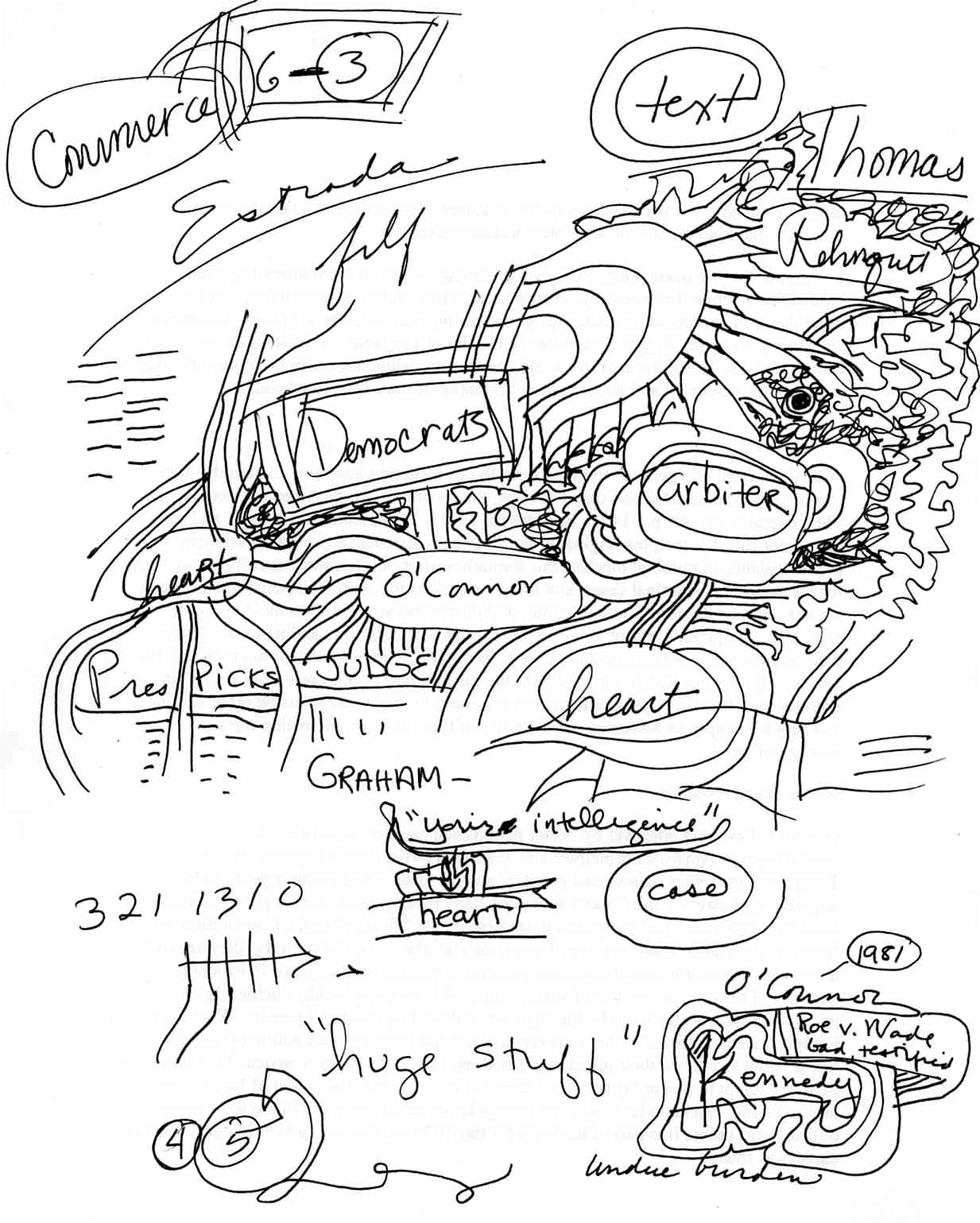
Now he's blabbering about the need for a heart. He seems to like to think about himself as representing heart.
Dianne Feinstein is next, and I realize only the Democrats are participating in this round. She compliments him on his "staying power." I wish someone would apologize for putting him through such an ordeal. She pesters him about a study about nine of his cases, which assertedly prove he's going to favor corporations against workers. He points out the statistical invalidity of a study of a mere nine cases. She pursues him about the Iran-Contra matter, and he indicates that he knows little about it. She persists. We see him sipping some water and squaring his shoulders and setting his face into the I-am-concerned-about-what-you're-saying position. I try to imagine the exact wording of his thoughts. Since I believe John Roberts is a human being, I'm guessing: Look like you care, it will be over soon.
I love the way the Democratic Senators act irritated every time he frames an answer in legal terms. Like it's evasive.
Russ Feingold is next, reading his prepared statement very fast. He engages Roberts over questions about habeas corpus. Roberts does a good job of explaining the problems that used to exist about repetitive petitions by prisoners. Congress itself agreed that these were problems and reformed habeas corpus in 1996. It's hard to pillory Roberts for hostility to the rights of convicted persons when Congress itself reformed the process. Feingold clearly knows this and doesn't go too far here. Please know that I regard Feingold as far superior to most of the other Senators.
Should I mention that Jane Sullivan Roberts, after wearing pink and then black, is wearing ivory today?
Skipping Sessions, we're up to the most hotheaded Senator, Chuck Schumer. Actually, Schumer charms me by laying his cards on the table. He knows Roberts is a top-notch litigator, so what question would Roberts ask if Roberts were Schumer and trying to find out if Roberts is an ideologue? Roberts says you've asked all the questions he expected, which makes Schumer say, "So I guess we did a better job than we think we did."
Schumer ends by acknowledging that they've put Roberts through a "grueling" ordeal, and he wins my admiration by saying that he's woken up in the middle of the night wondering what he should do with his vote. I've been assuming that Schumer would vote against Roberts, but I think he's figuring out that he'll seem unreasonable, even incomprehensible, if he votes no. He goes on to make a statement about how impressed he is by Roberts' profession of judicial "modesty," which he finds "appealing," but also wonders about what might be included in it, considering that he called Brown v. Board of Education modest. Will he overturn Wickard and Roe and call it "modest"? He asks a long series of questions about what Roberts will do, and he fairly observes that he genuinely doesn't know. Roberts answer is to assert that he is not an ideologue.
Well, it's gotten awfully late, and I'd like to do more, but I think I'm going to sign off now. I'll try to fill in some of the gaps that I've left tomorrow.
Are you worrying about me and my poor extracted tooth? I'm okay. I haven't even taken any Advil since this morning. The whole after surgery pain issue was overstated, in my opinion. But I do miss my body part. I mourn the loss!
First up for me is Patrick Leahy, asking about the FISA court and the threat it might pose to liberty. John Roberts says it concerns him too, but doesn't make it too bluntly obvious that Congress created that court.
Next is Ted Kennedy. He asks about the "50 million Americans" with disabilities. That makes me wonder who is included to get to such a large number. He's concerned about inviting all these persons into the mainstream and thinks anti-discrimination law should be uniform, federal law. Roberts gently informs him that there are some difficult legal questions, and Kennedy garbles through a statement that we can get to these legalisms later, but these decisions have an "extraordinary effect on people's lives."
Kennedy asks about affirmative action, and Roberts gives an eloquent answer in which he talks, among other things, about his participation in a program preparing minority students for the rigors of law school. (The point is that admission to law school is not enough. Students must be helped to do well after they arrive at the school, and he has worked at that.) Kennedy rejects a portion of the answer that refers to work involving Native Hawaiians, which Kennedy says was not really about affirmative action. I know nothing about that case, but I observe that Kennedy looks red and sounds blustery. His hands are shaky. I'm thinking he's agonizing, feeling the power draining out of him, as Roberts coolly stands his ground.
Now he's blabbering about the need for a heart. He seems to like to think about himself as representing heart.
Dianne Feinstein is next, and I realize only the Democrats are participating in this round. She compliments him on his "staying power." I wish someone would apologize for putting him through such an ordeal. She pesters him about a study about nine of his cases, which assertedly prove he's going to favor corporations against workers. He points out the statistical invalidity of a study of a mere nine cases. She pursues him about the Iran-Contra matter, and he indicates that he knows little about it. She persists. We see him sipping some water and squaring his shoulders and setting his face into the I-am-concerned-about-what-you're-saying position. I try to imagine the exact wording of his thoughts. Since I believe John Roberts is a human being, I'm guessing: Look like you care, it will be over soon.
I love the way the Democratic Senators act irritated every time he frames an answer in legal terms. Like it's evasive.
Russ Feingold is next, reading his prepared statement very fast. He engages Roberts over questions about habeas corpus. Roberts does a good job of explaining the problems that used to exist about repetitive petitions by prisoners. Congress itself agreed that these were problems and reformed habeas corpus in 1996. It's hard to pillory Roberts for hostility to the rights of convicted persons when Congress itself reformed the process. Feingold clearly knows this and doesn't go too far here. Please know that I regard Feingold as far superior to most of the other Senators.
Should I mention that Jane Sullivan Roberts, after wearing pink and then black, is wearing ivory today?
Skipping Sessions, we're up to the most hotheaded Senator, Chuck Schumer. Actually, Schumer charms me by laying his cards on the table. He knows Roberts is a top-notch litigator, so what question would Roberts ask if Roberts were Schumer and trying to find out if Roberts is an ideologue? Roberts says you've asked all the questions he expected, which makes Schumer say, "So I guess we did a better job than we think we did."
Schumer ends by acknowledging that they've put Roberts through a "grueling" ordeal, and he wins my admiration by saying that he's woken up in the middle of the night wondering what he should do with his vote. I've been assuming that Schumer would vote against Roberts, but I think he's figuring out that he'll seem unreasonable, even incomprehensible, if he votes no. He goes on to make a statement about how impressed he is by Roberts' profession of judicial "modesty," which he finds "appealing," but also wonders about what might be included in it, considering that he called Brown v. Board of Education modest. Will he overturn Wickard and Roe and call it "modest"? He asks a long series of questions about what Roberts will do, and he fairly observes that he genuinely doesn't know. Roberts answer is to assert that he is not an ideologue.
Well, it's gotten awfully late, and I'd like to do more, but I think I'm going to sign off now. I'll try to fill in some of the gaps that I've left tomorrow.
Are you worrying about me and my poor extracted tooth? I'm okay. I haven't even taken any Advil since this morning. The whole after surgery pain issue was overstated, in my opinion. But I do miss my body part. I mourn the loss!
Delayed Day 4 blogging.
I'll have some comments on the 4th day of the Roberts hearings later this evening. Right now, I've got to write something ... off-blog.
"Most public sculpture, especially in the Trafalgar Square and Whitehall areas is triumphant male statuary."
For balance: "Alison Lapper Pregnant." The 13-ton marble statue was unveiled today. Comments? Is the artist striking a blow for the rights of women and the disabled or is he exploiting women and the disabled for his own advantage? Does the intent to strike a blow for the rights of women and the disabled make it better art, worse art, or exactly the same level of art it would be if it were offered up purely for its form? And in a purely formal sense, is it good art?
MORE: I just heard a BBC News report on the sculpture, which included Robert Simon, editor of the British Art Journal, disparaging what he called "the thing":
He also noted — and I agree — that the head is especially badly done.
YET MORE: Who Alison Lapper is.
MORE: I just heard a BBC News report on the sculpture, which included Robert Simon, editor of the British Art Journal, disparaging what he called "the thing":
I think it is horrible. Not because of the subject matter I hasten to add. [I have a] lot of time for Alison Lapper. I think she is very brave, very wonderful but it is just a rather repellent artefact - very shiny, slimy surface, machine-made, much too big...
He also noted — and I agree — that the head is especially badly done.
YET MORE: Who Alison Lapper is.
"Maybe the milk of human kindness will run through you and you will not be so technical.''
So said the Senator, claiming he was trying to "sensitize" the Supreme Court nominee who was perceived as lacking in human feeling. The Senator was Howard Metzenbaum and the nominee was Stephen Breyer.
Subscribe to:
Posts (Atom)


 Posts
Posts